Showing posts with label Alexander Korda. Show all posts

Tuesday, September 8, 2009

Knight without Armor (in a savage land!)


This fun Marlene Dietrich/Robert Donat melodrama has all hallmarks of a great movie about the Russian Revolution: action, romance, dancing Tartars and wacky hats. Robert Donat plays a British journalist who, after being threatened with deportation from Russia, decides to assume a false identity and spy on revolutionaries. His cover is so good that when he gets caught and sent to Siberia by the Czarist regime, no one ever finds out he's a Brit. He manages to switch sides at will in the conflict to suit his purposes, which mainly involve cozying up to an imprisoned countess (Dietrich). Charged with delivering her to her probable execution, he decides to help her escape instead. This makes for a pleasant cross-country romantic adventure story that's not dissimilar from The Thirty-Nine Steps when you get down to it.

Perhaps because it's an English film, it feels quite a bit racier than typical American fare of the period (1937). Dietrich has no less than two gratuitous bathing scenes and she and Donat spend their time unchaperoned and unconcerned with sleeping arrangements. In one scene Donat tells her "They'll call off the search now. In a few days we can leave the forest." Dietrich inquires in her smokiest, most suggestive baritone "Don't you like my forest?" to which Donat replies, "I adore it" and they kiss, while the scene fades out. When next we see Dietrich she is skinny dipping, a scene reminiscent of the pre-code Blonde Venus (1932).

Though it was filmed in England and lacks that David Lean sweep of landscape that would make Doctor Zhivago an immortal classic, Knight Without Armor still manages to capture some of the insanity of that period of history. In a tense sequence Donat and Dietrich wait for a train that isn't coming, even though the station master insists on mustering passengers to the platform despite the obvious non-presence of the train. The longer they wait the more danger they face from Donat's own underlings who've decided to kidnap the Countess for themselves. There is a creeping irrationality to the peasants who are all mostly out for themselves and the good time to be had. The film presents no heroes or villains on either side, only individuals who are either sympathetic to the cause of the lovers or they are not. I suppose you could argue that this focus on the individual over the collective whole would be a way of taking sides after all.

At one point they encounter a young officer (John Clements) of the revolution who is so taken by the Countess' beauty that he deliberately allows them to escape, creating a diversion by killing himself. This conveniently allows the leads to have to avoid that big sacrifice that I was expecting from them, this being a 1930s melodrama. It also makes for some interesting dynamics between Donat and Dietrich. Donat uses the cover story that he and the Countess are brother and sister, so he has to sit by and watch while this young officer flatters and makes love to his girl. Donat applies his usual mask of indifference, appearing to trust Dietrich to prevent the fellow from going too far. In a beautifully filmed night scene, Dietrich reaches her arm out to Donat in the train car and he kisses it passionately, silently, all while the young officer looks on jealously. Yet, the young man never confronts the couple, preferring to push his advantage as far as he can, until he realizes that she will never love him. All of this is accomplished with minimal dialog and great skill from every quarter.

Certainly Knight Without Armor isn't a great film. Though Belgian director Jacques Feyder's other films are well-respected, this one is largely forgotten and I think it's partly his fault. The flow of the movie is a bit choppy and even occasionally hard to follow. There are scenes obviously left out (Dietrich's marriage and the death of her husband) and it isn't simply a case of a director deciding the audience is smart enough to fill in the blanks. It really seems as if he's not quite in control of the material or the pacing. Despite this criticism, I like the way he treats Dietrich as an actress rather than an object. He still manages to get her "little butterfly" in view in a few close-ups, but spends more care in setting up the drama the lighting. Take this clip which shows the moment when the Countess realizes that she is on the losing side in the revolution. Notice the time and elaborate set-up involved in building the drama of this scene. When Dietrich realizes that her servants have joined the rabble who've over run the estate, she is framed in a classic glamour close-up. She steels herself, asks "what are you waiting for?" and marches forward to face them. The crowd of rabble advances and an elderly woman from the crowd shouts, "c'mon she's only a woman!" The wit here is subtle, with Dietrich's power as a film star and her potency as a femme fatale being pitted against an angry mob.

There's a nice story attached to the making of this film, that stuck with me as I was watching it. Apparently during production Donat became ill and the film's producers wanted to replace him. Dietrich refused, saying that no other actor could play the part so well. She got her way and production was stalled till Donat could return. Perhaps all this really says is that Alexander Korda was more of a push over than Dietrich's usual Hollywood bosses. But it is nice to think of a little bit of chivalry involved in Knight without Armor, even if it is on the part of the damsel in distress.

Sunday, April 12, 2009

I'm Henry the VIIIth, I am

Once while driving across Iowa during a summer storm, I looked out my window and saw the corn, as high as an SUV's eye, swirling in an ominous cyclonic pattern. My radio which was tuned to the AM weather band, cut out. The air was thick and had a pea green cast and I was certain that I was going to be picked up any moment and hurled to Oz or my death. Suddenly, my radio came back on loudly playing Herman's Hermits "Henry the VIIIth I am." I'm going to die, I thought and the last thing I hear is going to be this ridiculous song. No sooner did this register in my fear paralized brain than my Isuzu Trooper past a line of trees, a shelter belt around a graveyard, and the cyclonic wind stopped. A wall of rain hit the car and the radio returned to static. I drove blindly, my wipers barely keeping up with the rain somehow knowing that I'd escaped the tornado and pondering the significance of a radio signal trapped in weather pattern. Perhaps, I'd merely dreamed the whole thing, like Dorothy.

I bring this up because I recently heard that Alexander Korda got the idea for making his film The Private Life of Henry the VIIIth (1933) when a cab driver began whistling "Henry the VIIIth I am" well known in music halls before Herman's Hermits took it to the rest of the planet, including Iowa. I wonder, what was the weather was like outside that London cab? Raining like mad, I'd bet anything.

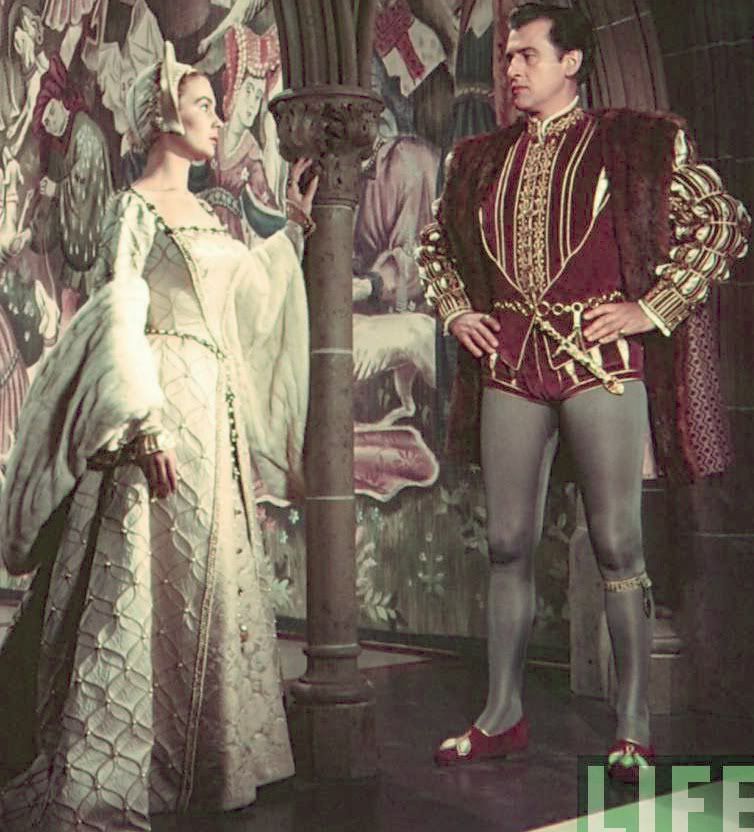
There is another, contradictory tale, about Korda that says that he got the idea for the film while standing under the famous Holbein portrait of the monarch and realizing that he looked a lot like Charles Laughton. I doubt this version of the tale, since Life magazine published a photo of Korda, and Laughton co-star Robert Donat standing underneath that same picture in 1948. Either Life set out to recreate this moment of inspiration or people are remembering a picture they saw and attaching more significance to it than it warrants.

I recently rewatched both of Charles Laughton's performances as Henry the VIII in Private Life and Young Bess (1953) and I'm positive that I assigned a lot more significance to the later performance than it warrants the first half dozen times I watched it. If I believed in guilt I would list Young Bess as definitely among my guilty pleasures having loved the movie for years for it's absurd dialog, Stewart Granger's legs and Charles Laughton's huffing and puffing Henry. His first Henry is tender, childlike and whimsical when he's not lopping off heads, his second is more a collection of tics and catch phrases than a flesh and blood character. I'm sorry to say this, because I love it anyway. It's not just that the movie is so bad it's good, it's that sometimes it's so good, it's good. I love the way that Laughton always stands as if he's straddling and imaginary globe and how Jean Simmons imitates this stance at every opportunity. I love that Bess and Tom (Stewart Granger) always discuss ships and they make talk of mizzen masts and gunwales sound downright naughty. I love the sentimental portrayal of the relationship between boy King Edward and Bess which has more of a basis in the demands of injecting phony "family values" into 1950s movies than with historical reality. (Not that anything in either of the movies is much more than malarkey in that respect. It's not so much what they get wrong, which is quite a lot, it's the over-simplification and over-dramatization of what they get right. Why is that in every movie about Henry the VIIIth he is always out hunting when Elizabeth was born? I've never been able to figure out where that comes from, other than costume drama tradition. )

Lots of actors have played the infamous king, from Richard Burton in Anne of a Thousand Days to Jonathan Rhys Myers in the recent television series The Tudors and most have brought something new to the character, but Charles Laughton pretty much made the template. Far and away my favorite Hank 8 flick is The Private life of Henry VIII (1933). I always think of it as a comedy, though it's usually billed as drama (I guess all those ladies loosing their heads isn't as funny as I think.) The biggest delight is the relationship between Henry and his fourth wife, Anne of Cleves (Laughton's wife, Elsa Lanchester). The pair have great comic timing with one another and despite their divorce Anne ends up being the only wife to remain on friendly terms with her notorious ex. Much of the drama is provided by Henry's fifth wife Katherine Howard (Binnie Barnes) and her lover Thomas Culpeper (Robert Donat). Barnes portrayal is an interesting one, managing to strike a balance between seeming sympathetic and overly ambitious at the cost of her life and her lovers. Donat is great as usual and one gets the feeling that the kind is more hurt by his old friend's betrayal than he is by loosing another wife. The movie ends on an up note with an elderly king henpecked into hiding his turkey legs from sharp-eyed Katherine Parr (Everly Gregg). Merle Oberon has a surprisingly small part as Anne Boleyn, whose story is perhaps too long and complex for the length of the film.

Wednesday, April 1, 2009

The Korda brothers, 1932

Last month TCM highlighted the films of the Korda brothers which was an especially big treat for me. Not only were some of my favorite films shown (That Hamilton Woman, Fire Over England and The Private Life of Henry the VIII) but I got to find see several films I'd never seen before. The excellent Vacation from Marriage, which I've already discussed and the almost equally excellent Wedding Rehearsal and Service for Ladies .

If you are half as fond as I am of Jeeves and Wooster or the world of PJ Woodhouse, you will probably enjoy Wedding Rehearsal . Imagine Jeeves and Wooster where Jeeves is a woman and she winds up marrying Wooster and you'll just about have it right. Roland Young gives an energetic and sparkling performance as Reggie, a gadabout playboy who enjoys his freedom and his bachelor lifestyle (complete with an affair with married woman) so much that when his granny presents him with a list of seven eligible women in England for him to marry he sets about making matches with his friends for all of them. The list is carefully prepared by his gran's companion, Hutchy, (Merle Oberon) who admires Reggie from afar given her status as little better than servant to his family. As in the world of Woodhouse, Reggie's friends are a lot of silly public school men who have names like "Toodles" and "Bimbo" and the women are flighty, rich and spoiled. The first names on his list are the Roxbury Twins, whom it is difficult to tell apart, excpet that one is a dog fancier and the other fancies cats. When the cats and dogs inevitably get together it constitutes a servant crisis as the poor retainers try to extricate the howling, scratching beasts. This is all very funny and since one of the dogs is a wire haired terrier like Asta, I couldn't help but feel shades of screwball comedy.

Reggie manages to get the Roxbury twins engaged to Toodles and Bimbo and it's one of the films best gags that Lord Roxbury refuses to get their nicknames right calling them "Boodles" and "Timbo" most of the time. When all upper crust society gathers for the wedding rehearsal Reggie is given an ultimatum, "get engaged this week-end or start over with next season's debutantes." Unable to face the prospect of more flighty, rich spoiled young women, Reggie does the sensible thing and falls in love with Hutchy. Merle Oberon is adorable looking though underused in her role. I think she can manage the Joan Fontaine routine quite well and it's a shame she didn't get more of these type of roles. She was a fairly able comedian and I've always liked her in the Divorce of Lady X with Laurence Olivier. I can't help but wish she was given just a bit more to do even though Roland Young very ably carries the bulk of the film with his hijinks. Lady Tree is particularly good as the Roxbury the twins' sweet, but dimwitted mother. So lets see you have barking dogs, a ditsy mom, an on again off again wedding, a rich man marrying his gal friday...Are you sure this isn't Columbia Pictures 1937? Nope it's London Films circa 1932 and the wonderful Korda brothers.

As part of my quest to begin to appreciate Leslie Howard I can safely say that I quite enjoyed him in Service For Ladies. I didn't exactly love him, but what can you do? I'm trying here, people. I should like Leslie Howard. He fits into that type I regularly go daffy for: English, stage-trained, handsome, and having the air of a man who is hiding a great deal of something interesting under his cool exterior. I think I've figured out that it boils down to his hair. When he lets his hair get messy he's great, (yay! Pygmalion) otherwise forget it. In Service for Ladies he plays a head waiter who is mistaken for royalty when he goes on vacation at a "winter sports hotel" in Austria. He falls in love with a well to do young American woman (Elizabeth Allan) and perceived class differences on both acounts keep them apart. The movie teases us with plenty of opportunities to mess up Howard's hair, but it never happens. He never goes skiing or ice skating or gets in a snowball fight. It's just not fair, how, long would it really have taken Korda brothers? Is this too much to ask? I think the answer to that lies in the fact that Service for Ladies was the Hungarian autheurs first film for an American company and was made on a total shoestring. Obviously Vincent Korda blew the entire budget for the picture filling every room in the "winter sports hotel" with dead animal heads and had no money left over to do a rear projection skiing sequence or to make a fake ice rink. Darn.

The story is further complicated when the Countess Ricardi (Benita Hume) shows up. It's heavily implied that she and Howard had an affair in the past but that he broke it off. The second half of the film turns into a fun bedroom farce with ladies popping in and out of Howard's room alternately kissing and slapping him. Eventually Howard's status as a head waiter comes out and the couple are sweetly reunited thanks to the good intentions of Howard's restaurant patrons who want nothing more than happiness for their favorite head waiter. So let's see you have a slightly naughty bedroom comedy, a slyly satirical knock at the upper classes, and a grand case of mistaken identity...Are you sure this isn't an Ernest Lubitsch film? Nope, again Korda brothers, 1932!

Friday, March 13, 2009

The war made us really hot: Vacation from Marriage (1946)

Deborah Kerr and Robert Donat look amazing in their naval uniforms.

One thing you can say about the second world war, it really did wonders for the sex lives of the English. For some reason the line from Hope and Glory, comes to mind, "Thank you, Adolf."

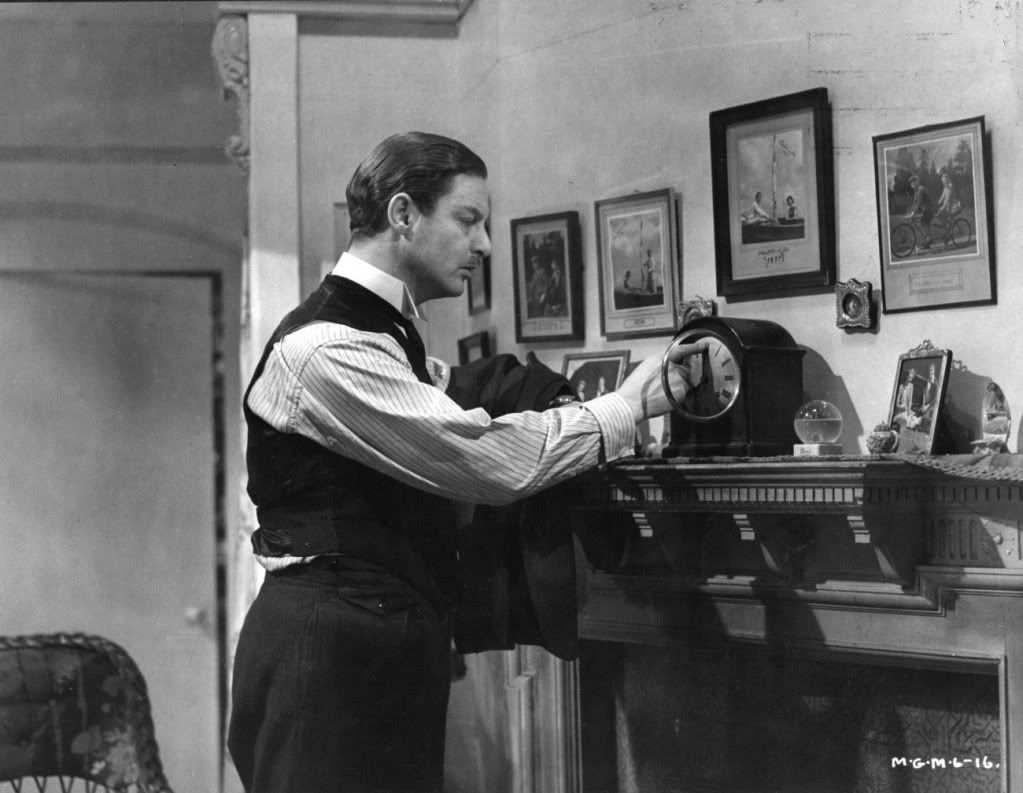
In Vacation from Marriage (or Perfect Strangers as it was billed in England) the Wilsons are a nice quiet couple who are feeling middle age closing in fast while they are stuck in a cramped flat with no view and the prospect of another day of uninspiring work ahead of them. Kathy Wilson (Deborah Kerr) has a perpetual head cold and an even more perpetual look of glazed dispair. She eschews dancing and makeup to humor her stuffy, mustachioed husband (Robert Donat) who is a clerk in some sort of soul-crushing British business enterprise. Even their vacations at the requisite Clacton-on-sea have grown stale. You could set a watch by their movements until Mr. Wilson is sent off to the war in the service of the Navy. His wife, bored keeping up with her taxing nose-blowing and clock winding duties joins the The Wrens, a female service corps of the Navy. Their physical health improves with regular exercise and their personalities are spruced up a bit with danger, independence and a change of scene. Kerr especially blossoms before the camera, moving from an almost flat blank face to the pin up girl with a brain we see her as at the end of the film. She pilots a boat up the Themes in an air raid, and I would say it worth the danger for the effect that it has on her hairdo and the amazingly cute sailor's uniform she gets to wear. I would have joined the Wrens just for the duds!

Both of the Wilsons have wartime romances with partners far more dashing than the spouses they left behind, meanwhile they describe the other to their friends in a mixture of affection and loathing that is really unique to the film. The war scenes are short, but well-filmed and effective. There is a feeling of genuine danger, perhaps owing to the fact that they were filmed in authentically blitzkreiged London. After three years apart, the couple are reunited on a ten day leave. Each plans to ask the other for a divorce. What I expected was a quick denoument, the equivalent of the Pina Colada Song with air raid helmets, but the actual ending was more fulfilling than that. After fighting all night long, the couple who never had so much as a harsh word before the war, are reunited as the sun comes up and it is suddenly clear that German bombs have taken out the high wall that encloses their suburban neighborhood from a spectacular view of the city below.

Though the film is billed as a comedy it is pretty short on laughs. Vacation from Marriage is still an absorbing romance with excellent acting and production values. Director Alexander Korda makes war-torn London seem beautiful and exotic.