Showing posts with label Charles Laughton. Show all posts

Wednesday, November 4, 2009

Island of Lost Souls (1932)

Ah, Charles Laughton. He could rock an insane character like no one else. Six months after playing a bonkers submarine commander in The Devil and Deep (1932), he tackled the mad scientist Dr. Moreau for this Paramount horror movie. Bela Lugosi was hired for his horror movie gravitas, though he's mostly wasted in a small part, "The Sayer of the Law." I confess, I couldn't pick him out of a beast man line-up to save my life. He does get to utter the most famous line of the film, "are we not men?" which was inspiration for Devo to ask the question decades later.

Richard Arlen rather woodenly portrays the protagonist Edward Parker who is stranded on the island. Parker is disturbed by Moreau's experiments-- the "unsuccessful" examples are used as slaves and the "House of Pain" that the islands inhabitants fear is a vivisection lab. He decides to keep quiet about things in order to get off the island more quickly. After meeting Moreau's creation, Lota the panther woman, (Kathleen Burke) he changes his mind about keeping quiet.

Moreau quickly moves from being a hospitable if eccentric host to being completely crazy, deciding that he's going to keep his new house guest to mate with Lota to prove once and for all that his creations are perfectly human. What's completely insane about Moreau and is never really addressed is the question of exactly what the doctor's experiments are supposed to do to help humanity? In Frankenstein, the ability to reanimate the dead could seemingly have profoundly positive benefits, but why go around making a race of mutants, if the only point is to prove that animals can be turned human? Aren't there plenty of regular humans walking around who were made the old-fashioned way? South Park pretty much nailed this flaw in the story in their parody, in which the mad scientist makes turkeys with multiple asses. Really, what's the point, dude?

My favorite part of the movie is Lota. You gotta love Lota. And indeed, until he finds out her secret origin, Parker is completely prepared to ditch his fiancee back on the mainland to have a shot with her. Paramount, desparate to hype the film, had held a nation-wide contest to cast the part and Burke won. Though she never really hit the big time, she proved more than capable in the movie and went on to play more exotic temptresses in Paramount classics such as The Lives of The Bengal Lancers and The Last Outpost.

Bonus Eye candy:
A whole lotta Lota!

Sunday, April 12, 2009

I'm Henry the VIIIth, I am

Once while driving across Iowa during a summer storm, I looked out my window and saw the corn, as high as an SUV's eye, swirling in an ominous cyclonic pattern. My radio which was tuned to the AM weather band, cut out. The air was thick and had a pea green cast and I was certain that I was going to be picked up any moment and hurled to Oz or my death. Suddenly, my radio came back on loudly playing Herman's Hermits "Henry the VIIIth I am." I'm going to die, I thought and the last thing I hear is going to be this ridiculous song. No sooner did this register in my fear paralized brain than my Isuzu Trooper past a line of trees, a shelter belt around a graveyard, and the cyclonic wind stopped. A wall of rain hit the car and the radio returned to static. I drove blindly, my wipers barely keeping up with the rain somehow knowing that I'd escaped the tornado and pondering the significance of a radio signal trapped in weather pattern. Perhaps, I'd merely dreamed the whole thing, like Dorothy.

I bring this up because I recently heard that Alexander Korda got the idea for making his film The Private Life of Henry the VIIIth (1933) when a cab driver began whistling "Henry the VIIIth I am" well known in music halls before Herman's Hermits took it to the rest of the planet, including Iowa. I wonder, what was the weather was like outside that London cab? Raining like mad, I'd bet anything.

There is another, contradictory tale, about Korda that says that he got the idea for the film while standing under the famous Holbein portrait of the monarch and realizing that he looked a lot like Charles Laughton. I doubt this version of the tale, since Life magazine published a photo of Korda, and Laughton co-star Robert Donat standing underneath that same picture in 1948. Either Life set out to recreate this moment of inspiration or people are remembering a picture they saw and attaching more significance to it than it warrants.

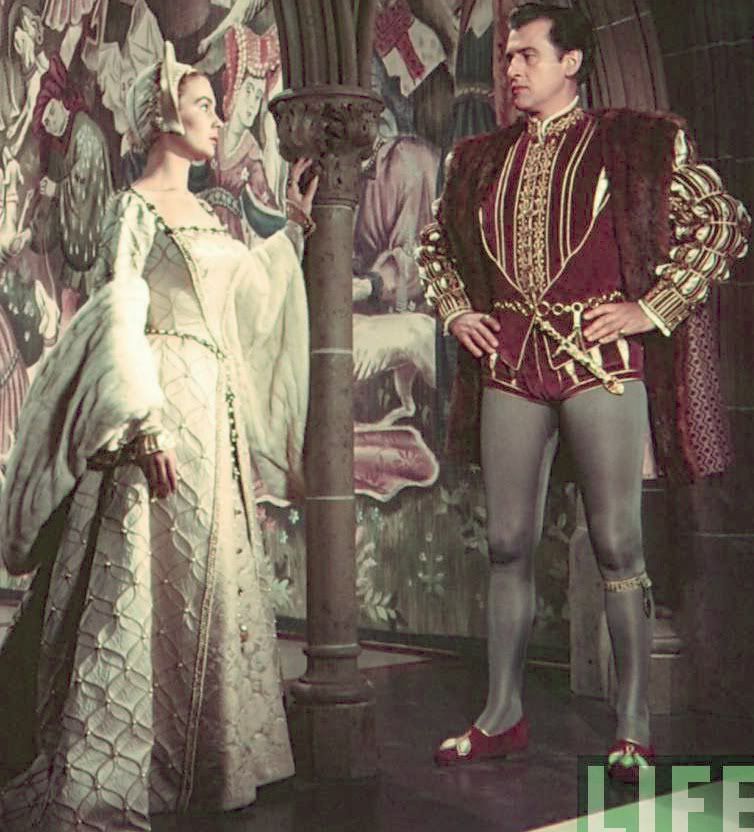
I recently rewatched both of Charles Laughton's performances as Henry the VIII in Private Life and Young Bess (1953) and I'm positive that I assigned a lot more significance to the later performance than it warrants the first half dozen times I watched it. If I believed in guilt I would list Young Bess as definitely among my guilty pleasures having loved the movie for years for it's absurd dialog, Stewart Granger's legs and Charles Laughton's huffing and puffing Henry. His first Henry is tender, childlike and whimsical when he's not lopping off heads, his second is more a collection of tics and catch phrases than a flesh and blood character. I'm sorry to say this, because I love it anyway. It's not just that the movie is so bad it's good, it's that sometimes it's so good, it's good. I love the way that Laughton always stands as if he's straddling and imaginary globe and how Jean Simmons imitates this stance at every opportunity. I love that Bess and Tom (Stewart Granger) always discuss ships and they make talk of mizzen masts and gunwales sound downright naughty. I love the sentimental portrayal of the relationship between boy King Edward and Bess which has more of a basis in the demands of injecting phony "family values" into 1950s movies than with historical reality. (Not that anything in either of the movies is much more than malarkey in that respect. It's not so much what they get wrong, which is quite a lot, it's the over-simplification and over-dramatization of what they get right. Why is that in every movie about Henry the VIIIth he is always out hunting when Elizabeth was born? I've never been able to figure out where that comes from, other than costume drama tradition. )

Lots of actors have played the infamous king, from Richard Burton in Anne of a Thousand Days to Jonathan Rhys Myers in the recent television series The Tudors and most have brought something new to the character, but Charles Laughton pretty much made the template. Far and away my favorite Hank 8 flick is The Private life of Henry VIII (1933). I always think of it as a comedy, though it's usually billed as drama (I guess all those ladies loosing their heads isn't as funny as I think.) The biggest delight is the relationship between Henry and his fourth wife, Anne of Cleves (Laughton's wife, Elsa Lanchester). The pair have great comic timing with one another and despite their divorce Anne ends up being the only wife to remain on friendly terms with her notorious ex. Much of the drama is provided by Henry's fifth wife Katherine Howard (Binnie Barnes) and her lover Thomas Culpeper (Robert Donat). Barnes portrayal is an interesting one, managing to strike a balance between seeming sympathetic and overly ambitious at the cost of her life and her lovers. Donat is great as usual and one gets the feeling that the kind is more hurt by his old friend's betrayal than he is by loosing another wife. The movie ends on an up note with an elderly king henpecked into hiding his turkey legs from sharp-eyed Katherine Parr (Everly Gregg). Merle Oberon has a surprisingly small part as Anne Boleyn, whose story is perhaps too long and complex for the length of the film.

Friday, December 5, 2008

Jamaica Inn

Charles Laughton and 19-year-old Maureen O'Hara in Jamaica Inn (1939). The pair had kind of a creepy chemistry which worked to the advantage of this picture as well as The Hunchback of Notre Dame later that year.

Jamaica Inn feels almost as much like a Tod Browning movie as it does an Alfred Hitchcock film. It creates a dark mood, full of grotesque characters and swirling seas. To me the words "Jamaica Inn" conjure up a caribbean resort or perhaps a lair for pirates. The latter is close to truth, as the Inn is a dilapidated hotel on the stormy Cornish coast that is home to a band of ship wreckers-- cutthroats so nasty, each one is more bizarre and devilish than the last. In one scene a man is hung and two of the wreckers fight over the buckles on his shoes before he's even dead. Further adding to the piratical air of the film, is hero Jem Trehorne, portrayed by Robert Newton the patron saint of "Talk Like a Pirate Day" who is best remembered for his portrayal of Long John Silver in Disney's Treasure Island.

When young Mary Yellen (O'Hara) goes to visit her aunt on the storm-torn coast of Cornwall, the stage drivers refuse to stop at the desolate Inn. She is dropped off instead at the estate of Sir Humphrey (Laughton) a lecherous old aristocrat who lives for lavish dinners and the occasional pretty face. We learn that Humprey's ancestors have all gone mad and Laughton gives us every indication that he's got his ticket to Happydale all but punched and ready to go.

The movie devolves into an extended chase when Mary rescues Newton's character, the 19th century equivalent of an undercover cop, from the wreckers. In one sequence the pair wind up stranded in a cave that gets cut off from the mainland by high tide. The romantic setting is reminiscent of Hitchcock's later travelogue films that made great use of location. Jamaica Inn isn't a great Hitchock film but it's quite a bit of fun and Laughton is always worth watching.

Friday, October 31, 2008

Horror movies for non-horror fans


Happy Halloween! To celebrate the day I've put together a list of scary movies (one per decade) that may appeal to those of you,who, like me, would rather watch ten obscure pre-code films than one horror movie.

Well how about starting it off then with an obscure pre-code horror movie? The Old Dark House (1932) starring Charles Laughton, Melvyn Douglas, Boris Karloff, Raymond Massey, Gloria Stuart and Lilian Bond and directed by James Whale is a good old-fashioned things that go bump in the night kind of movie. This film doesn't use a lot of fancy effects or make-up to create horror. It uses the darkness, tension and the sound of wind on a stormy night in Wales to create the atmosphere. Because it's pre-code, there's a bit of raciness in that Lilian Bond plays a show-girl whose shacked up with Charles Laughton but falls in love with a traveling stranger played by Melvyn Douglas. They manage to sneak in a rather sweet romance in between screams.

The Uninvited (1944) is another things that go bump in the night movie about a couple that rent a haunted house on the English Coast. It stars Ray Milland, Ruth Hussey and Donald Crisp. The ghost is kind of annoying rather than scary. I enjoyed this movie priamarily because I love Ruth Hussey and it was great to see her in a such a big part even if she only plays the hero's sister.

Eye Without a Face (1959) This French film is creepy in the extreme while making a really powerful statement about the beauty culture in which we live. Pierre Brasseur plays a mad scientist trying to restore his daughter's face which was horribly disfigured in a car accident. He keeps her prisoner while he kidnaps women, and attempts to remove their faces and surgically transplant them onto hers. All this goes down rather poorly with daughter and her fiancee who thought she died in the accident.

The Innocents (1961) starring Deborah Kerr is a brilliant adaptation of Henry James' novel "The Turn of the Screw." This is agreat ghost story whose techniques of filming have been borrowed so frequently since that it doesn't quite seem as pioneering as it probably did in the early sixties. This movie relies almost entirely on tension, lighting and music to convey the horror. The creepiest scene in the movie takes place in broad daylight. Kerr is always wonderful, but here she is at her best conveying the sense of rising terror and panic that may or may not be her own hysteria.

The Wicker Man (1973) is another movie that is almost all atmosphere and tension. Edward Woodward plays a police detective sent to a remote island in the Hebrides to investigate a missing child. The great horror veteran Chirstopher Lee plays Lord Summerisle, Woodward's adversary. One unnerving and unsettling event after another happens leading the audience down the garden path to the film's surreal and horrible conclusion.

The Changeling (1980) Looking back on my list, there is a predominance of haunted house movies, but this is probably the scariest of the lot. The contemporary Japanese horror film Ringu and it's American re-make, The Ring, borrowed heavily from this tale of lonely man (George C. Scott) in haunted house trying to solve the mystery of its former occupants. In most haunted house movies you wonder why the occupants don't just leave after the first incident, but the Changeling offers the explanation that this man would really rather have a ghost as his companion than no companion at all.

The Blair Witch Project (1999) If you can take all the cursing and the horrible hand-held camera work, this is possibly the scariest movie of all time. Relying on pyscological tension and a few well placed gimmicks, the story follows three film students who get lost in the woods. The innovative techniques used to make this film on a miniscule budget make it legendary. No film in my recollection has caused such a polarized reaction. Peoople either bought into and thought it was scary as all get out as I did, or they were bored silly. I saw this film in the theater when it first opened and my friend and I literally clinged to one another through the second half of the movie. I happeneded to be scheduled to go on a ten day camping trip right afterward. Just hearing the sound effects in the trailer is enough to get my heart rate up to this day. This movie has been parodied enlessly, but that is only a reaction to the complete hold it had on pop culture one summer.