Showing posts with label noir. Show all posts

Friday, July 17, 2009

Doctor Noir: Take the Blue Dahlia and call me in the morning.

After a spate of low-grade noir recently, one of my readers issued the prescription of watching some good Alan Ladd film noir as soon as possible. Luckily I had a movie to fit the bill, The Blue Dahlia (1946), already and waiting in my tivo.

The Blue Dahlia is the story of a returning war hero, Johnny Morrison, who is greeted upon his return with the news that she's leaving him for another man, and that their son who died while he was away, was killed in a drunk driving accident and not from diphtheria which she'd let on her letters. Not exactly the home-coming any GI would want. It gets worse, after the understandable fight that ensues after hearing these two whoopers back to back, the fellow storms out, meets a beautiful, enchanting woman Joyce Harwood, (Veronica Lake) and spends the night with her (in separate bedrooms of course, this was 1946 people) in a hotel. Ladd learns that his wife has been murdered while he is checking out of the hotel. He nonchalantly goes about his business as the news of her death is played on the radio. He realizes that he is the chief suspect and his actions (fleeing the apartment in a rage, meeting a beautiful woman who is heavily connected to the case and leaving town with her) look mighty incriminating. It turns out Joyce Harwood is married to Eddie Harwood, the slimy owner of the club, the Blue Dahlia, and the man for whom Johnny's wife is leaving him. All these facts play across the couple's face plus a hundred emotions at once. If ever there were a single scene that sumed up power of showing versus telling in a movie, it's that one.

This is a masterfully told detective story. Director, George Marshall (Destry Rides Again), gives you just enough detail to keep you following along, but not so much that the solution is ever obvious. There are several skillfully placed red herrings that will trip up even the most die-hard detective story nut. The supporting cast is superb, especially William Bendix as Ladd's war buddy. But the real joy of watching The Blue Dahlia is watching Veronica Lake. The movie never drags when she's off-screen, but when she's on screen it comes to life. The quality of a film noir is directly bound up with the quality of its femme fatale. A good one will make the movie. A bad one (and I mean in acting ability and appeal, not morally bad) will ruin everything. See my review of The Lady in the Lake for further proof if required. Lake and Ladd have incandescent chemistry together. I hadn't realized it before watching one of their films, but they really are one of the great screen pairings. This was their third noir film together and you can see the benefit of the earlier two films in their first scenes in the car. There is a perfection of timing that actors who work well together have after two or three pictures that's always a joy to watch. Sometimes the later outings, though not as original as those that made them famous, can actually be more enjoyable for fans because of this perfection. Of course I haven't seen the Glass Key or This Gun for Hire yet.

The Blue Dahlia does suffer from one of my most frequent complaints about noir and that is the irrational behavior of its characters. Ladd's wife is a horrible spiteful person, and we come to understand why she would act that way out of guilt over her son's death. What is truly puzzling is why her lover would cheat on Veronica Lake with her. Even more baffling is that he almost leaves her over the affair. And then of course, one wonders what Veronica Lake is doing with sleazy Eddie in the first place.

Tuesday, June 2, 2009

Lady in the Lake

I was ten minutes into this movie, when I slapped myself on the forehead and said, "oh no! Not THIS thing." I had seen part of Robert Montgomery's disastrous first person camera version of The Lady in the Lake in some point in my past and repressed it. Somebody in 1947 needed to take the actor/director aside and tell him two things: Christmas music has no place in film noir, and if a filming technique has never been used for an entire movie there's probably a good reason for it. I'm sure as a first-time director, Montgomery was trying to be generous and give the spotlight to his fellow actors. If that was the case, just cast someone else as the lead. I won't go so far as to say that Montgomery's face was his only good attribute as an actor, but a movie that depends entirely on his voice is not as enjoyable as one in which we get the whole package. His performance as Philip Marlowe feels very stagy and what exactly is that accent he's trying to do? He is not helped by his leading lady Audrey Totter whose main acting technique is to bulge eyes out every once in a while like an unfunny, unappealing Lucille Ball.

As you can see from the poster, Lady in the Lake was billed as "the most revolutionary picture since talkies began." The genius in marketing who came up with that deserves to have to watch this stinker once a week for life. It's really too bad that the movie was executed so poorly, because Raymond Chandler's "The Lady in the Lake" is one of the all-time great detective stories. It deserved high-style forties noir treatment. What it got was a garbled plot and a lot people trying to punch or make out with a camera. Oh, yeah, and for what it's worth, there's no lake in it either. The original story begins with discovering the body at Little Fawn Lake. This mess begins with Robert Montgomery addressing himself in the mirror.

There are moments in the film, such as the discovery of a dead body, where the first person camera work and the creepy Christmas music are actually effective. But one suspenseful sequence does not make up for the excruciating minutes of "real time" where nothing much happens and the payoff for all our waiting around is to hear Montgomery huffing and puffing away in the background while we watch the surface of the ground moving slowly in front of us. Yeah, I get it, he's half dead and crawling along, but why would I want to experience that for myself?

This must be my week for bad noir, but really after Lady in the Lake, Bette Davis in The Letter seems like Citizen Kane, or at least The Postman Always Rings Twice. I feel like I need to watch Double Indemnity as soon as possible or I'm in danger of giving up on the genre all together.

Thursday, April 9, 2009

Sunset Boulevard: on Monkey Funerals

With the topic of film noir coming up recently on this blog, I've been thinking about what constitutes "noir." I've seen Sunset Boulevard (1950) on numerous lists of film noir, though I've mentally never categorized the film that way myself. Maybe because the movie is so funny. But it does have most of the trappings of noir: a mystery, a body, a voice over and a dark view of the world.

On my most recent trip through the film, the thing that struck me was what motivates Joe Gillis (William Holden) to stick around after things start getting weird at Norma Desmond's house. I think it has to do with the monkey funeral that he witnesses shortly after moving into the room above her garage. The kind of person who would hold a big funeral for her ancient pet monkey is the kind of subject a writer, even a failing one, can't resist. Joe sticks around because he tells himself that Norma would make a fascinating topic for a screenplay. And she does, as the movie attests. I have coined the term "monkey funeral" for any time that you stick around in a potentially unhealthy situation just because your storytelling compunction or artistic sensibilities won't let you leave. This is different from a "train wreck" in that there has to be at least a small potential that there will at least be a great anecdote born out of the experience, whereas the main pull of a "train wreck" is simple morbid curiosity.

Of course, there are the material advantages that Joe gains by sticking with Norma: debts are paid off, rent is no longer a concern and he's swimming in fine clothes and gold cigarette cases. Yet, I think he bristles under these attentions and he does not actually begin sleeping with Norma until he gets sucked in emotionally. Norma's New Years Eve suicide attempt should be another monkey funeral, but at this point, I think Gillis feels something, even if it's just guilt.

Anther thing that struck me this time through is that Norma really has her moments of being charming. It's not such a bad life lying around watching her put on little skits. Swanson is at her most attractive when she dumps the ridiculous get-ups and and buckets of makeup to dress up like Charlie Chaplin. Gloria Swanson's performance is especially brave, because they must have gone out of their way to make her seem every inch the desperate older woman trying to hang onto her youth. As Joe tells her, "there's nothing wrong with being fifty Norma. It's only when you want to convince everyone that your twenty, that it's sad." And yet, Joe proves her right by leaving her for a younger woman.

Eric Von Stroheim gives a great performance as well, more or less playing a looking glass version of himself. Max is a great German director who becomes so attached to his younger protege that he is willing to give up his career and any personal life to protect her. It's difficult to understand that kind of a sense of responsibility, which is what makes it such an interesting and watchable tale. Joe Gillis was right. These people are fascinating.

Wednesday, March 18, 2009

The Playsuit Always Rings Twice

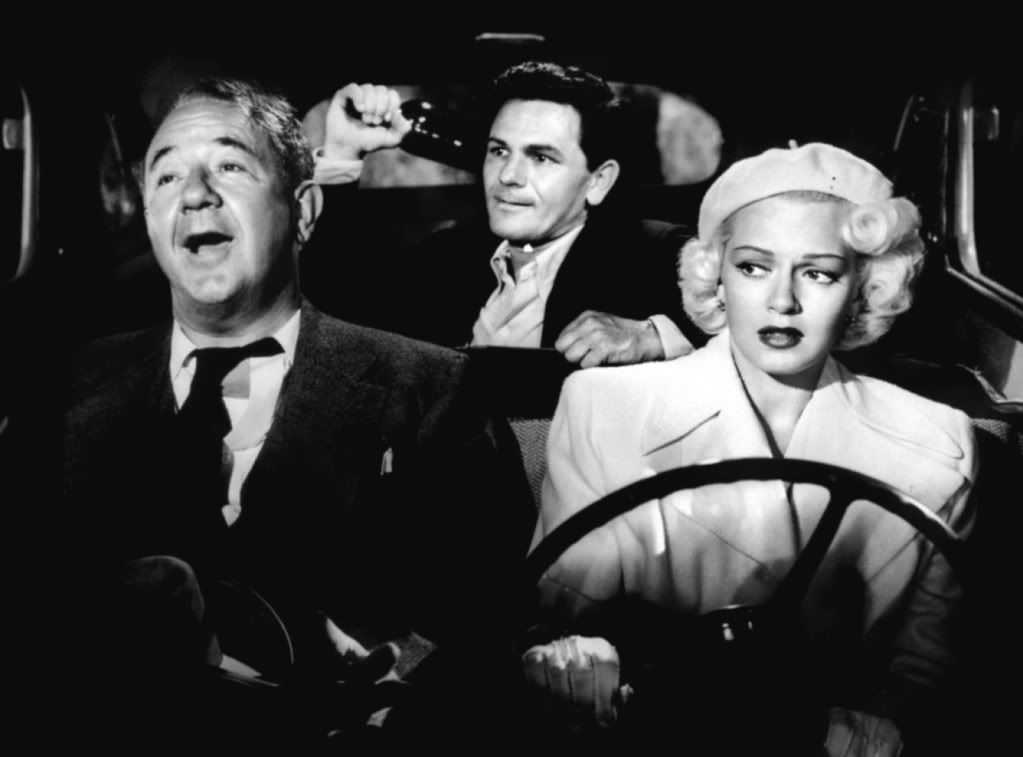
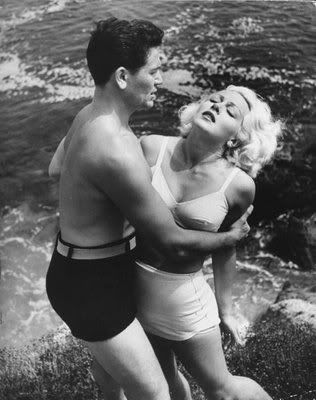
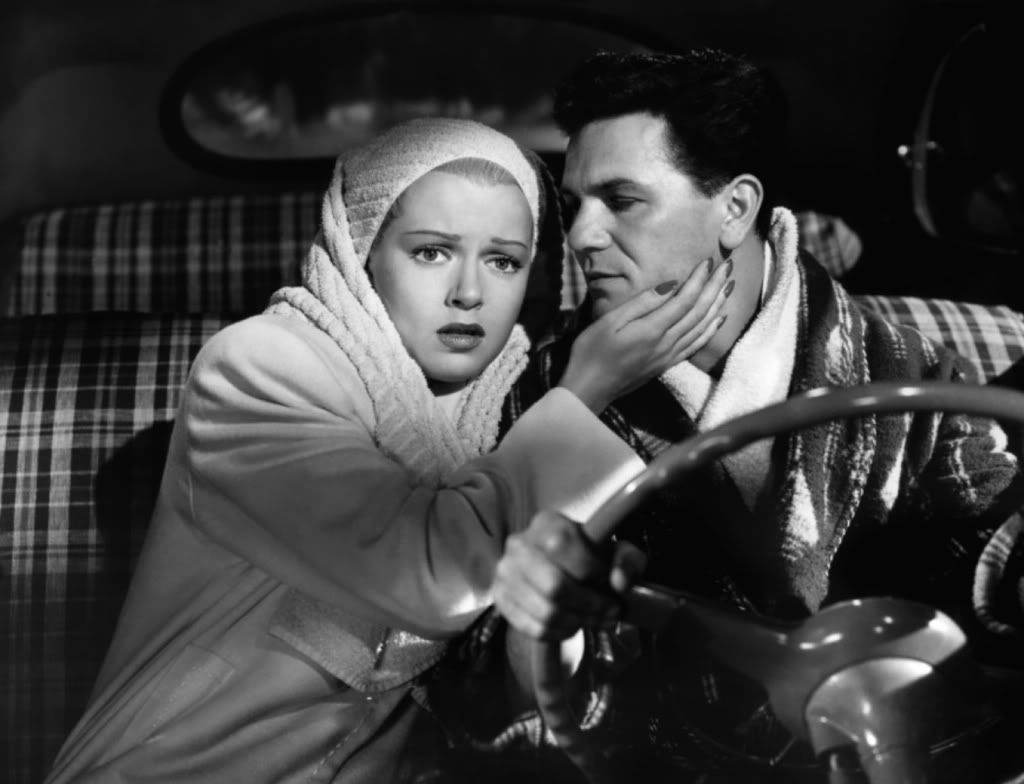
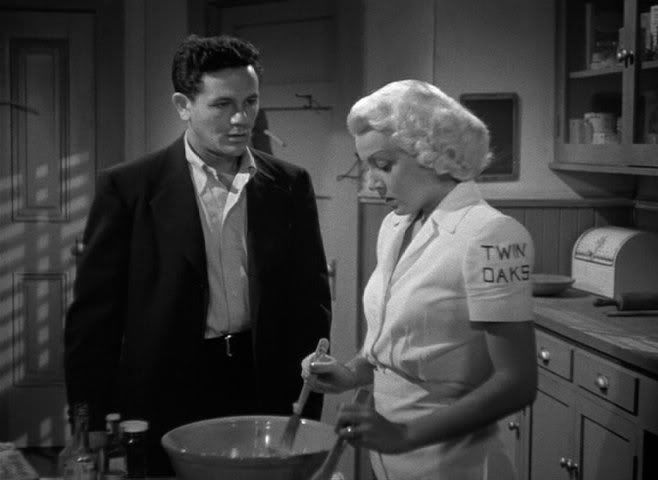
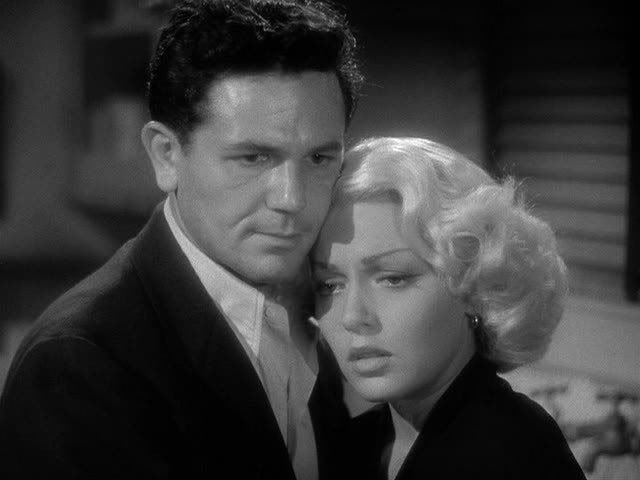
When I think of film noir, I almost always think of The Postman Always Rings Twice or Double Indemnity, both based on novels by James Cain. While Postman is not my favorite film in the genre , there is one thing I absolutely love in this movie and that is Lana Turner's wardrobe. She is ironically clothed almost entirely in white. We are first introduced to her character by a rolling white tube of lipstick moving toward the camera. The camera follows along with John Garfield's hungry eyes back up toward Lana standing there head to toe in the white playsuit with that quirky turban and those to die for peeptoe platform pumps. She wears white when she sets out to murder her husband-- a white wool trench and matching beret. She wears white to the beach and on the day she dies, her character exiting with a lipstick rolling off camera. I love the iconic white keyhole dress and the dozen matching white waitress uniforms with "Twin Oaks stenciled on the sleeve. I love that one evening she sits while her husband plays the guitar and polishes her white workshoes, a nother pair of to die for white platform maryjanes. Pretty much I love everything about this movie that has to do with clothes.

The wardrobe works wonderfully, as irony but also to complement Turner's platinum locks which read as white on the silver screen. A further irony, her trademark hair makes make but rare appearances as she is often veiled, hatted, hair-netted or turbaned. At one point John Garfield spots a sexy red headed waitress and says "I'm going to try to work that blond out of my system." Appropriately the waitresses dress is isn't white. The subtle message by the filmakers here is that though their relationship is sordid and wrong their is a kind of purity in it. They do love one another. It's not all just about sex.

The only scene in the film where Turner isn't clad in white is the one in which she and Garfield face down a sleazy cop who tries to blackmail them. Though they aren't exactly sympathetic characters at this point, after all they just murdered a nice man who happened to be in the way of their ambition, they are almost victims of a corrupt authority. As their love affair begins to unravel under the inevitable suspicion and bad karma resultant from their crime, Lana remains in black.

She returns to white in the final scenes as the couple go to somewhat ridiculous lengths to regain their trust and in a way, purify their relationship. They go swimming. They just keep swimming until one of them is about to drown and needs the help of the the other to return to shore. I said at the beginning of my post that Postman isn't may favorite film noir. I think part of it has to do with this kind of nonsensical plot devlopment. It's not just a problem with the movie, but the genre as a whole. As a piece of symbolism, as an allegory about good and evil, Postman works and so does film noir. As a reflection of the way the world actually is, I think the genre is hopelessly muddled. In attempting to show the dark side of life in the paradigm of the Hayes code where evil always had to be punished, we get a very skewed version of reality. I'm much fonder of the 1970s versions of film noir Chinatown (1974), The Long Goodbye (1973) and Farewell My Lovely (1975) which are able to trade in ambiguous morality and remain entertaining detective stories. I hate the remake of Postman (1981) though because rather than address the moral ambiguities presented in the novel in a more honest way, it simply dumps a bucket of sex onto a story that really didn't need it. If there's one thing, besides wardrobe, that the original film really got right it was the chemistry between Garfield and Turner.