Showing posts with label Herbert Marshall. Show all posts

Thursday, February 25, 2010

Merrily We Live (1938) and If You Only Could Cook (1935)

Merrily We Live has been on my Wish List for years. TCM has started showing it recently to my delight. It's difficult to describe the movie, without using the words "My Man Godfrey" and "derivative," and yet this is a wonderfully enjoyable film. I will go so far as to say I enjoyed it at least as much as the earlier far more famous flick. Billie Burke plays the ditsy mother whose habit of hiring tramps as chauffeurs has left the family destitute of silver. An early scene has the family eating breakfast using kitchen utensils. She received a Best Supporting Actress nomination for the role. Despite the "forgotten men" as servants/love interests plot device, this movie is derived from different source material, a 1926 play, "They All Want Something" and the first film incarnation of it, What a Man (1930).

Brian Aherne plays Wade Rawlins a novelist who has a car accident on a fishing trip and stops at the Kilbourne mansion to use the telephone. Assuming he's a tramp looking for work, he is whisked away, protesting loudly, to be be suited up as the family's new chauffeur. One look at him in his work duds and heiress Jerry (Constance Bennett) is a goner. This is one of those moments where 1930s sensibilities are lost on me. While I think Aherne looks pretty tasty in his scruffy fishing outfit, shown above, chauffeur's uniforms always remind me a little too much of Berlin in 1939. It hardly signifies what he wears because when a tramp who isn't really a tramp and an heiress are in the same movie together, it's a sure bet they're gonna wind up getting married.

All the supporting cast are excellent including Bonita Granville as aspiring thespian/rich brat (territory that Virginia Wiedler had pretty well sown up in my book), Ann Dvorak as the chief rival for Rawlins' attention, Patsy Kelly as the sassy kitchen main and Alan Mowbray, as the family butler who quits at least once a day. This family is so screwball, even the dogs are funny, with names like "Down Boy" and "Off the Carpet" though sadly there are no wire-haired terriers present.

To add to the Dreamboat in Disguise as Servant sub-genre, If You Only Could Cook (1935) features Jim Buchanon (Herbert Marshall) as an automotive mogul who, after a rough day at the office, meets Joan Hawthorn (Jean Arthur) on a park bench while she's looking through the want ads. Mistaking him for a fellow job-seeker, she invites him to pose as a married couple in order to get jobs as a cook and a butler. Marshall of course, has his own butler, who he hits up for tips, before heading off for a few weeks vacation as a servant. Only in the movies!

Lionel Sander, best known as Max from the TV series Hart to Hart has a supporting role as one of the gangsters in the employ of Mike Rossini (Leo Carillo). The mob boss hires the couple, and then falls for Joan, which presents complications for Jim who is also in love with her. Oh, and I forgot to mention, Jim is supposed to be getting married to a woman he doesn't love in a few days. As is the way in screwball comedy, it all works out right in the end after much confusion over sleeping arrangements in the couple's cramped servant's quarters. One of Sander's lines, "If you were married to her, would you sleep on the sofa!?" sums up the tensions that drove the entire screwball genre.

Marshall doesn't quite go through the mistaken for a "forgotten man," routine. It's enough for him merely to sit on a park bench and to be branded as unemployed. Arthur is plucky and funny as usual. She always plays well as the wiser and more worldly member of a couple, and it's a nice twist to see reserved Marshall cast as her love interest. Mr. Smith and Mr. Deeds were hicks, but they were also dreamers, as is our Mr. Buchanon. He's just a bit more sophisticated.

Familiar tropes are sometimes the best because their variations delight and amuse almost more than those films which are entirely novel. During the Depression there was no greater fantasy than being a rich person with servants, unless of course it was that you were rich, your servant happened to look like a movie star and be a millionaire in disguise.

Thursday, January 14, 2010

Mad About Music (1938) versus What A Girl Wants (2003)


I was watching this Herbert Marshall movie recently (I'm shocked, SHOCKED, you say) and it really reminded me of this Colin Firth movie, I may or may not have taped off the Disney channel. (I admit NOTHING.) If either Herbert Marshall or Colin Firth interest you, you may find it amusing to know that they made pretty much the same movie about 60 years apart: Mad about Music and What a Girl Wants.

Both films were vehicles for their teen idol female ingenues. Mad About Music showcases the singing and acting of young Deanna Durbin and What a Girl Wants showcases the talents of Nickolodeon-spawned singer/actress Amanda Bynes. Both movies feature a teenage girl getting to know her father, though in the case of Mad About Music, Marshall's character isn't really her father, but a composer at rest in the small Swiss town where Durbin is at boarding school. She randomly picks him up from the train hoping to prove to her friends that her made-up safari hunting daddy is real. The deceit causes confusion, some rather thin laughs and is an excuse at one point for Durbin to fake-yodel (Faux-dell?) In What a Girl Wants Colin Firth is a British politician whose newly discovered teenage daughter could cost him an election. Naturally the deceit causes confusion, some rather thin laughs and excuses for musical interludes. I may be tipping my hand toward the past a bit, but the music in What A Girl Wants made me positively pine for the fauxdelling.

OK so I admit 90% of writing this post was the needing an excuse to post this picture of Colin Firth barefoot. In very high resolution. Right-click save, my foot fetish friends. Right Click Save.

In many way Firth and Marshall have similar career trajectories. They both played leading men (and the occasional stock Brit villain) in romantic comedies. They always seem to be mid-thirties, somehow, in these films, though Marshall didn't become a movie star until he was forty. He played young, until one day, he started finally playing middle-age. At a certain point the leading man roles became thin on the ground so they switched to playing cuckolds, married playboys and dads. Both these movies are early entries in the "dads" ouevres for both actors. Firth still manages the occasional romantic comedy lead, but really his fans should get used to seeing him playing father to precocious teenage girls. Try not to vomit. It's Colin Firth. He's totally worth enduring the likes of What a Girl Wants. Oh hey speaking of Colin Firth, Mick LaSalle named Bridget Jones Diary the best romantic Comedy of the decade. So yay! And there's some talk that he might win an Oscar or something, in which case I may have to break my decade of indifference to the ceremony.

It's an encouraging thought that movie musicals tend to still be made for young people. I may not like the music, but then I'm not really supposed to. One fun thing about Mad about Music is the appearance of a harmonica band in the final scene. I just watched the movie a week or so ago, but already I've forgotten the preposterous plot excuse for a harmonica band turning up at a girl's school in Switzerland. I've always had a soft spot for harmonica bands ever since I found that Jerry and the Harmonicats record in a dumpster. (I mean really, how could you throw something like that away. The cover alone is priceless, but I digress...). If I gave stars to movies, I'd give an extra star to Mad about Music for Cappy Barra.

Monday, January 4, 2010

Blonde Venus (1932)

I cringed, I cried like I was chopping a great big sweet vadalia and gosh darn it, if I didn't enjoy myself thoroughly. That's my one sentence, Gene Shallit-zed review of Blonde Venus.

This is one of many early Cary Grant films that I watched mainly for Cary and more or less forgot about. Grant has a smallish part as Nick Townsend the millionaire playboy who gets entangled with married showgirl Helen "Jones" Faraday (Marlene Dietrich.)

The next time I watched the movie, I was keeping an eye out for Herbert Marshall plays Dietrich's husband, a chemist, who is dying of radium poisoning. He needs $1,500 for the cure. His wife goes back to work on the stage, but decides she can make the money more quickly by shacking up with Nick Townsend. While her husband is in Germany being cured, she and Townsend have a long fling that includes some speedboat riding--one of Hollywood's favorite visual codes to represent free love.

It's clear that Dietrich has feelings for Townsend but decides to return to her husband. Unfortunately, he gets cured a few days early and comes home to an empty apartment and the unopened telegram, explaining his early return. Not exactly overwhelmed with gratitude when he finds out just how his wife raised the money to save his life, he threatens to divorce her and take custody of their son, Johnny. Dietrich kidnaps Johnny, played by professional toe-head Dickie Moore, and spends the next two reels hiding from her husband and the various private detectives he hires. When poverty, starvation and exhaustion catch up with her, she reluctantly returns the boy to his father. Dietrich is devastating here, looking every inch the hungry bag lady with torn clothes and hollow cheeks. You can see she's sacrificed for her kid who is returned to daddy looking a bit disheveled but the picture of ruddy health. Audiences were used to seeing Dietrich as the vamp, but here she plays a devoted wife and mother, albeit with her own peculiar spin on the institution. Of course, director Joseph Von Sternberg would never let her look dowdy and for my money Dietrich is never sexier than she is riding in a hay wagon with Johny singing him a German lullaby.

Speaking of lullabies, what makes Blonde Venus rise above the typical melodrama, are the three numbers Dietrich performs: I Couldn't Be Annoyed in her trademark tuxedo, the charmingly unintelligible You So and So and Hot Voodoo, a production number that you have to see to believe. When I saw Blonde Venus in a theater about a decade ago, this scene drew audible gasps from the audience. Dietrich arrives on stage in a fairly realistic gorilla costume with a back up chorus of black dancers in "native African" (in a 1930s nightclubby kind of way) costume. She pulls off the gorilla head to reveal a blond afro wig with rhinestone studded arrows poking out. Can you say "racially insensitive" boys and girls? But dang if it ain't also highly entertaining.

After the music, the thing I appreciated most was the complex nature of this love triangle. Dietrich is torn between two men, both of whom she cares for; and two lifestyles, both of which have attraction. There are no villains or heroes here. I won't go so far as to say it's realistic. Remember the radium poisoning, the gorilla suits and the speed boat. It's just that the decision to return to her husband isn't as pat and pre-figured as it would be if it were made a few years later.

Blonde Venus humanizes Dietrich's image one minute and immortalizes it the next with plenty of lavish costumes and Sternberg-ian lighting set-ups. Dietrich is an icon today in part because her irony and her androgynous and sophisticated sexuality still resonate with modern audiences. She has a unique style of singing, talking, even walking that is undeniably fascinating. And yet, I don't think she would be as popular today if she had not proven time and time again that she really could act. Blonde Venus is some of her strongest work. Though I watched it for her co-stars, they are little more than arm candy. It is Dietrich who owns the film and captures every second of the audience's attention.

Monday, December 21, 2009

Angel (1937)

Angel was the first film Ernst Lubitsch directed under the production code. And it shows. You can see Lubitsch struggling against the Code. His usual "touch," that light unobtrusive slyly sexual humor that his best movies exhibit, is a bit off somehow. To add to Angel's troubles, the film was cut down by twenty minutes to please the studio. That also shows. There are chunks of explanatory dialog missing. I was confused about the opening scene of the film, expecting it to be explained in the end and it simply wasn't. Worse, you can see moments where Lubitsch had given the actors space to actually react to things and those are pared down in the most noticeable way. In one scene Herbert Marshall comes to realize that his wife is the woman, "Angel" that his buddy Melvyn Douglas has been nattering on about for two reels. The film fades to black right in the middle of Marshall's reaction. His face is still changing. It's most disconcerting and I can only blame Paramount for this incompetence because I can't see a genius like Lubitsch actually pulling such a hack move.

Dietrich plays Maria Barker, wife of an important British diplomat, Sir Frederick Barker (Herbert Marshall) whose time is consumed by attempting to make peace in the Pre-World War II era. Through a slight case of mistaken identity she meets Tony Halton (Melvyn Douglas) in the Grand Duchess' Salon, which is far as I can tell is a cross between a single's bar and a brothel. The Grand Duchess, ably portrayed by Laura Hope Crewes is part time agony aunt to Maria with whom she has some mysterious, never quite explained connection. Halton shows up on the recommendation of a never-seen Captain Butler (remember this is two years BEFORE Gone With The Wind, I think the name was merely coincidence) looking for a good time. Maria offers to show him the Louvre, the Eiffel Tower and Notre Dame, though that's not what he had in mind. Those reading along might think some of this sounds remarkably similar to Ninotchka, made by Lubitsch also with Douglas and a fake Russian Emigre, Greta Garbo a few years later. But Angel is no Ninotchka and it's a bit of a puzzle as to why. Dietrich and Douglas' early scenes together, so critical to the believability of the rest of the film, are leaden where they should be light and ponderous when they should be breezy. I like both these actors separately, but together in these early scenes, I can't wait for the movie to well, move along.

I literally said aloud, "oh thank God!" when I saw Edward Everett Horton's face in the next scenes. Now, we are actually going to have a comedy, I said. Well, almost. Horton has a small part that he does his best with as Graham, Barker's loyal manservant who judges the various European powers by the manners of their representatives at the League of Nations. He holds them all up to be lacking compared to those of his master, Sir Frederick who is smooth, easy-going and impecable in every way a butler could wish for. Unfortunately he's not so impeccable in every way a wife could wish for. After a wonderful bit of Lubitsch nonsense involving mixed up sleeping arrangements in the bedroom suite (the highlight of the movie for me), we see that Maria and Frederick's relationship is more or less platonic. I love Herbert Marshall and all, but really man, do you need a B12 shot or something? Can I get you a plate of oysters? This is Marlene Dietrich telling you about a dream she had in which you beat her and she quite liked it (Oh Lubitsch and his references to S&M are one of my favorite little quirks) and you run off to answer a telegram from the Yugoslavians. Sigh.

At a scene quite reminiscent of Notorious, Maria spots Halton at races through a pair of binoculars and begs to go home with a headache. Speaking of Hitchcock, the whole pre-World War II vibe is very Foriegn Correspondent-ish, right down to the fact that Maria and Sir Frederick have the exact same enormous Great Dane as Marhsall's character does in the later Hitchcock film. Wierd. Anywho, inevitably Halton and Sir Frederick meet, discover they once shared the affections of the same Parisian woman during the Great War and become fast friends. When Douglas and Dietrich are reunited, the sparks finally fly and both actors are really wonderful at showing just enough emotion to let the audience know what they are thinking. The way Douglas says "Hello, Angel" when they are finally alone together is enough to make me almost root for him. And that's saying a lot because y'all know I'm bananas for Herbie. Marshall and Douglas seem to enjoy being with each other more than they do Dietrich, which makes me wonder if Lubtisch wasn't just trying to remake Design for Living with the promise of "no sex" actually coming true. Marshall and Douglas' scenes together all slap you on the back old man, make you a gin and tonic and light your cigarette. I could just about watch 90 minutes of this camaraderie, but if it Lubitsch had allowed it to go on a second longer I would be convinced that it was the two guys who were lovers after all.

I wouldn't discount any Ernest Lubitsch film entirely. Though it's been difficult to find in the U.S. , some kind soul has uploaded it to Youtube. It is worth watching to appreciate the enormous tension wrought by Lubitsch in this comedy that wants to be a thriller. It wants to be Notorious. How I ache for Marshall to come out at the end and admit he's a fat-headed guy full of pain. Actually, almost any movie would be better with that as the ending. Dietrich keeps hinting that she could be a spy when she first meets Douglas. I kept hoping that would be the case. Her marriage would be revealed as a sham so she could run off with Halton. Graham and Sir Frederick could live happily ever after in a Jeeves and Wooster rip-off drawing room comedy.

Saturday, November 21, 2009

Foreign Correspondent (1940)

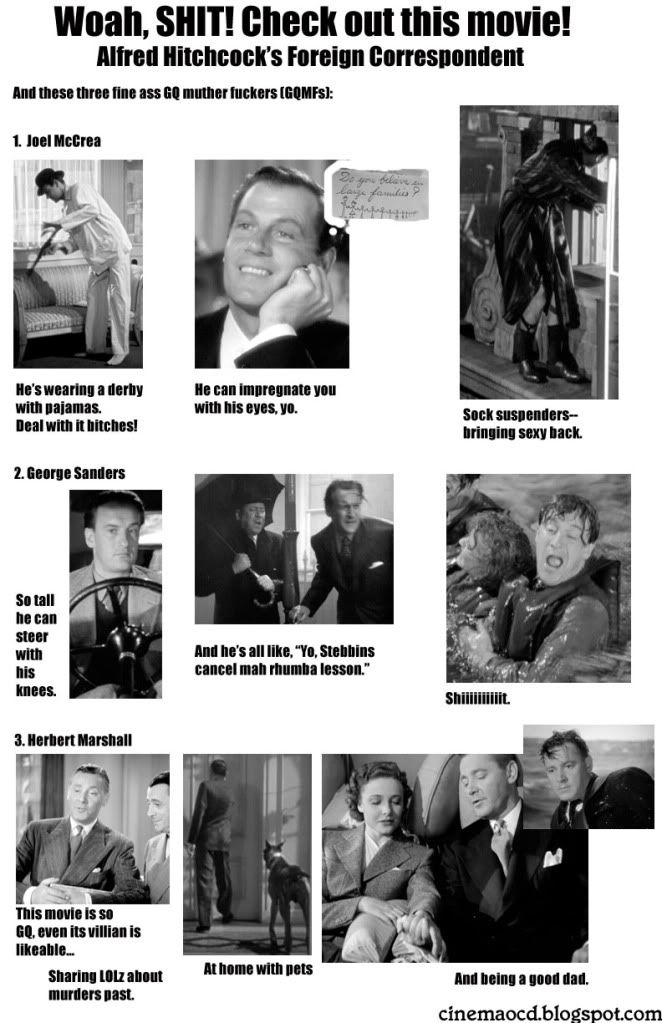
The lesser known and loved of the two great films put out by Alfred Hitchcock in 1940 (the other being Rebecca), Foreign Correspondent is sometimes lost in the shuffle of Hitchcock's oeuvre. While I watched this movie in a film class at some point, I mainly remembered the famous umbrella sequence and that some of the plot devices are later rehashed in North by Northwest. Coming back to the movie with my obscure actor love goggles on, I can't believe how jam packed with awesomeness this movie is and I didn't even know it till a week ago.

I always feel that while commenting on Hitchcock movies that I have to really struggle to say something new. I tried doing a picspam commentary on Murder! which, based on the number of comments I received, was met with crickets chirping. This time I'm really going to shake things up with a macro using a fairly popular internet meme created by the ONTD livejournal communities.

So here goes, the first ever OCD Macro, printable at the 11x17 tabloid size, if you REALLY wanna show your love for Cinema OCD.

And while we are showing mad love for George Sanders, please enjoy this lovely, in-depth article about him. Watch him in one of best be-monicled scenes here.

Thursday, August 13, 2009

Murder! (1930) Picspam

There is an awesome website called "1000 frames of Hitchcock" that is part of the extensive Hitchcock Wiki. The site does just what it sounds like it does: they post 1000 frames from every Hitchcock film. The people who are doing this must really love Hitch. Doing a picspam of 60 frames is a huge amount of work, let alone 1000. It was worth the effort though, as the result reveals Hitchcock's greatness in a unique and powerful way. You can select just about any frame at random and find an artfully composed, striking image. He really was an artist hiding out in the world of popular entertainment.

I've gone through "1000 Frames" and selected my favorites from the 1930 film Murder! which I recently watched for the first time. I put my comments on the film as captions to the pictures. Rather than make my blog impossibly hard to load, I've put this in my live journal. You can see the whole thing here.

A note on other picspams: I still have not finished the Big Chill Picspam. All the captures are done and processed, but I haven't had a chance to put it together. I have yet another picspam of the Bull Murray film Razor's Edge, which I'm also going to try to post soon as well.

Sunday, August 2, 2009

Secrets of a Secretary (1931)

Claudette Colbert and Herbert Marshall in Secrets of a Secretary. Thanks to Trouble in Paradise for the image.


Claudette Colbert plays, Helen Blake, the secretary in question, whose secrets include: an ill-advised marriage to an fortune-hunter who left her to become a gigolo the moment he found out her father was broke, the fact that her employer is cheating on her fiancee, that she is in love with said fiancee and he is in love with her. It gets even more complicated when its revealed that her employer's lover is none other than her not-quite ex. Herbert Marshall plays the fiancee, an English Lord Danforth who gets stood up so much that he falls in love with the secretary whose job it is to continually inform him that her boss has been detained by some mysterious engagement or another. The film is unusually frank, even for pre-code and one sequence inter-cut Lord Danforth and Helen enjoying an innocent dinner while Helen's boss, Sylvia Merritt visits her lover's seedy hotel room.

Later that night, Helen and Lord Danforth decide to go dancing at the club where her ex now works. There's a great moment when Helen realizes the cheesy crooner in the floor show is her husband. Lord Danforth sneers at the gigolo, laughing about the kind of man who would do such things and the kind of woman who would be taken in by him. The irony is that his fiancee was with the guy hours earlier and of course, Helen, looks particularly miserable as she reveals that he's her husband. I have a perverse love of these kinds of scenes in movies and especially when they happen to Herbert Marshall. He always underplays, and its wonderful to watch him squirm quietly as he processes this plot complication and attempts to find something to say to Helen that will make him seem less of an ass.

Mary Boland plays Sylvia Merritt's socially obsessed mother and though she gets little screen time, as always, she makes it count, providing the film's only comic relief. It's a sad commentary on the lack of longevity for female actresses, that though she was only ten years older than the romantic lead in this film, she ends up playing his mother-in-law to be.

Secrets of a Secretary depicts a woman working, earning her living and freeing herself of relationship mistakes. Her job is somewhat humiliating given that a few years earlier she was herself attending the types of parties for which she now sends out RSVPs on behalf of someone else. She describes herself as "an upper servant" and it reminds me of the fact that the boss falling for his secretary is merely an updating of the old "master of the house falls for his governess" plot. Though there is that fairytale aspect to the story, there isn't the feeling that the heroine can't manage by herself. Indeed, it is only after she deliberately makes herself prime suspect in her husband's murder in order to preserve Lord Danforth from scandal, that she really needs the guy's help.

Tuesday, July 28, 2009

Bananas for Herbie: The Good Fairy (1935)

I've always maintained that the difference between a merely good romantic comedy and a great one is that the latter needs to have a strong supporting cast and has to be funny enough to stand on its own if one excised the "romance" from the film. Preston Sturges and William Wyler in their adaptation ofthe stage play "The Good Fairy" put this theory to the extreme test. The male romantic lead, Herbert Marshall, doesn't appear until 45 minutes into the film and he doesn't meet up with the heroine, Margaret Sullavan, until the movie is more than half over.

Sullavan and Marshall really have very few scenes together but boy do they make them count. The turn the quirkiest dialog, mostly in praise of pencil sharpeners and fake fur, into something like the boiled down essence of romance, sex and longing. Marshall and Sullavan are howlingly funny in these vignettes because they are so utterly sincere. Take Cary Grant's devotion to his intercostal clavicle in Bringing Up Baby, multiply it by ten and you'll begin to understand what I'm talking about.

The contrast between sincerity and phoniness, between niavete and cynicism is a perpetual theme of Sturges' films and Margaret Sullavan is the perfect actress to express this contrast. Her Luisa Ginklebusher is an unholy combination of innoncence and sensuality that breezes into the film and completely takes over. It's no wonder that Frank Morgan's wolfish millionaire is entirely smitten and is reduced to repeating "oh you're WONDerful" in that characteristically sing-songy Frank Morgan way.

The supporting cast is not just strong, they are Olympic weighlifter strength. Beulah Bondi and Alan Hale have tiny but memorable parts and even a throwaway steroetypical wolf character is played by a willy Ceasar Romero. Frank Morgan is great and while I've found him occasionally one-note in movies before this, he actually brings a complete, complex character to life here. Eric Blore has a stand-out turn as the drunken Dr. Metz and Reginald Owen makes the movie for me as Getloff, the waiter turned impromptu gaurdian. I've seen some films where Owen has small parts before and frankly I'd never really noticed him. He's a very able comic actor and he Sullavan have great timing together. There is something so charming about a cockney waiter with airs and a good girl with ideas that their scenes could almost be a movie on its own. If I wasn't so bananas for Herbie I wouldn't have cared if they would have just let him wind up with the girl at the end.

Thursday, July 23, 2009

Eye Candy of Day: Four Frightened People

What is more awesome than Herbert Marshall and Claudette Colbert in a romantic comedy melodrama action adventure film? Herbert Marshall and Claudette Colbert wearing leopard skin in a romantic comedy melodrama action adventure film!

This campy Cecil B. DeMille spectacular was more than a little bit responsible for the enforcement of the Production Code. Claudette Colbert has an infamous nude scene that worked the censors into a frenzy. It's tame by today's standards of course, but hot stuff for 1934. Herbert Marshall is adorable in it too. "I didn't want you to get pneumonia." I'll bet!

Colbert plays a shy, bespectacled school teacher of whom it is said, "girls like her chaperone themselves. Right into the old maid's home." She is shipwrecked with Arnold Ainger (Herbert Marshall) a shy rubber chemist and Stewart Corder (William Gargan) an earthy American journalist, and Mrs. Fifi Mardick (Mary Boland) the obligatory aristocrat complete with lap dog. It doesn't take long before Colbert looses her glasses and goes native. What fun!

Thanks to Four Frightened People, I've gone bananas for Herbie this week and made a Herbert Marshall Picture Gallery as well as a Youtube Playlist. Enjoy!

Monday, July 20, 2009

In praise of mdeiocrity: Girl's Dormitory


A good film is always a joy to watch. Sometimes a bad film can be a joy just because it's fun to mock it or to laugh at the unintentional humor. But I want to talk about something that is rarely loved--the mediocre film. The main joy that I get from mediocre films is re-writing them in my head. Often these movies have a great deal of potential and you can see where the writers went wrong. The Norma Shearer/Herbert Marshall melodrama, Riptide, for example was just begging to be produced as a comedy. I spent more time imagining the scenes re-written as farce than I did watching the movie. Any movie is worthwhile that lingers in your mind for more than the run-time of the film. This probably accounts for why I give so few negative reviews to films on my blog.

Girl's Dormitory (1936) had every promise of being a bad film: a somewhat lurid title, the whiff of scandal, and an unseemly love triangle between two teachers and a pupil at a vaguely European boarding school. Perhaps if this film had been made a few years earlier it could have really sunk deep in the swamp of these tantalizingly tawdry motifs. It might have even elevated itself to the status of legendary camp or better yet, it could have miraculously become a good film. It might have actually made an honest exploration of the various power imbalances inherent in May-September romances. It could have been "Lolita" ahead of its time. Simone Simon would have made an astoundingly effective Lo. Though she was 26 in 1936, she came off as younger even than the 19 years she is supposed to be in the film. She also has a worldliness about her that it is probably simplistic to describe as merely "French," an epithet hurled at her in one scene. She instinctively knows that her older, stodgy, quarry is going to need more prodding than usual. It's too bad for the film that her rival doesn't have those same Gaelic instincts. Speaking of Lolita, there is even a creepy scene in the movie where Herr Director Stephen Dominik (Herbert Marshall) talks with nostalgia about what Marie (Simon) was like when she came to the school at age 15. Another scene, in which Marie unceremoniously dumps Dominik, shows me that the filmmakers understood some of these imbalances but weren't brave enough to spell them out. Marshall creates Humbert Humbert twenty years before Nobokov even dreamed of him, briefly, in that scene as a mixture of heartbreak, humiliation and utter desperation plays across his face.

What we are left is a post-code romance that is set-up to be fairly formulaic and even there it could have turned out to be a better movie than it did. Everything in the movie is crying out for Dominik to realize his mistake and admit that he's in love with fellow teacher, Anna, ably played by Ruth Chatterton. With more loose ends than an old tapestry, a very short run-time at under 80 minutes, it seems like the filmmakers just panicked and left the audience with an unsettling, contrived "happy" ending between Dominik and Marie. This is further confused by the presence of a very young Tyrone Power whom I was completely convinced was brought on board in the final reel to remove the young girl from the neck of our very middle-aged hero. (Marshall was actually 46 when he made this movie, though he makes a fairly convincing 37. He did have a baby face. ) I guess I wanted The Bachelor and the Bobbysoxer: the uncomfortable older man played for laughs juxtaposed with a comically serious young heroine. I would have even been happy with the story left as melodrama, as long as it had a different ending, not so favor of youth and beauty.

One of the more glaring unresolved plot dilemmas is the investigation into Marie's supposed affair which is sparked by a pretend love letter she writes to Dominik. After a group of hard-nosed faculty threaten to call the girl's invalid mother into the school, she runs away in a rainstorm, Bronte style, nearly jumps off a cliff and spends enough of the night unchaperoned in a cabin with the good Herr Director to cause suspicion. Instead of seeing this as an admission of guilt or evidence of a deeper conspiracy, these teachers, whose actions were unbelievably prosecutorial to begin with, suddenly have a change of heart and see her disappearance as proof that she wasn't guilty. It gets worse. Dominik is made aware that Anna is in love with him, but this revelation has no effect on him, despite the three or four scenes to the contrary earlier in the film. I can see problems for his character either way he chooses to go. Sting didn't write "Don't Stand So Close to Me" in a vacuum. This situation could pretty much wreck his career no matter what. There is a narrow ledge that comedy walks to rid itself of the taint of unfair scandal, and it usually involves a public trial in which the true feelings of all the characters are revealed. Frank Capra knew this which is why he employed the device so often. Though the movie had a golden opportunity for such a set-piece through the investigation, it is never utilized.

The few people whom I've seen comment on this film have felt that it simply puts forth outdated mores. When one of the teachers says "After all, she is 19. My mother had two children by the time she was that age," it caused me to involuntarily squirm in my seat. Perhaps audiences in 1936 were OK with characters marrying young or more ready to accept the idea of an older man with a much younger woman, but I still think they would find the notion that a middle-aged man would throw over the very attractive and devoted colleague for a girl half his age to be a bit foolish. I can't imagine that audiences would buy the way in which Chatterton gracefully bows out, counseling both of them as her friends as an acceptable fate. It's made worse by the fact that all this is done off-screen and is summed up in an after-the-fact conversation at the end of the film. And what about the disadvantages for Marie? Is she going to wake up some day at 35 and find her self married to an old man? I simply refuse to buy the "outdated" argument. The mores described in this movie are more than just outdated, they are simplistic, wrong-headed and they must have appeared so, even in 1936. Indeed, the contemporaneous New York Times review says as much, while going on at length about the charms of Si-MOAN Si-MOAN.

Monday, June 1, 2009

The Letter (1940)

The Letter starring Bette Davis and Herbert Marshall is a classic example of why I really don't like film noir very much. People behave in completely stupid and irrational ways in order for most of the plots to work. The lead characters in noir are required to be short-sighted and mad in their objectives, which limits the depth of the characters and the actors who can play them. I'm sure this mirrors real life somewhat, but it is equal parts movie exaggeration. The genre seems to demand the cool, aloof beauty with a heart of stone, the lustful clever man and the hapless chump to be the victim. But what happens when the actors portraying these types are just too different, too smart, too nuanced to fit into these molds? Well, what happens is a film like The Letter.

The film begins on a moonlit night on a rubber plantation in Singapore, the camera panning over a shed full of dozing workers, moving across the yard to the plantation house. Shots ring out. Leslie Crosbie (Davis) comes to the door pursuing an unseen man. She puts four more slugs into him, in front of half a dozen witnesses, calmly orders the "head boy" to bring the police, before retiring to her room to smoke cigarettes. Her husband, Robert (Marshall) arrives along with the police and their family lawyer, Howard Joyce (James Stephenson) and the three men coo over her while she calmly tells how the man, Jeff Hammond, tried to "make love to her" before she filled him full of lead. The police and her husband are beside themselves with admiration for her strength and dignity in defending her honor. The lawyer is a bit suspicious. At this point, I wanted to shake Herbert Marshall till his head popped off, but he goes on being decent, thoughtful and totally blind to his wife's obvious flaws. For her part, I began to wonder why she would cheat on a man who was so obviously devoted to her and who is, after all debonair, handsome Herbert Marshall.

Davis plays the role as cool as ice, never letting on until the films last act just what her attachment was to the dead man. Since we never see him except as a corpse or learn much about his personality it's difficult to understand why she would prefer him over her husband and why she is so in love with him when it becomes clear that he treated her pretty shabbily. The bulk of the film is taken up with a letter from the defendant to the dead man that threatens to send Leslie to the gallows where she belongs. Her lawyer compromises his principals to save her because he he so fond of her husband that he doesn't want him to find out what she's really like. And he may be infatuated with her as well. It's difficult to tell because their scenes together are kind of nebulous and Davis plays everything so aloof and quirky that you can't tell whether she's trying to seduce Howard Joyce or not.

Davis wasn't particularly well suited to the stereotype of femme fatale. She's too intellectual, too neurotic (the film's most clever ploy is to channel her restless energy into lace knitting which becomes a symbol for her sexual frustration) and not the right kind of sexy for this. I'm not saying Bette Davis wasn't a sex symbol. She was, but primarily, I think her appeal was to women and men who liked a woman with spirit and brains. She was a thinking man's pin up. Not the sort of knock out who inspired the animal lust that will drive men to do completely stupid and irrational things. In short, she's no Lana Turner. Herbert Marshall, though flawless as usual is perhaps the wrong type to be the likeable chump/victim. He's too handsome, charming and well-matched with Davis to fit the type. In short, he's no Cecil Kellaway.

The Letter
is worth watching for noir fans as it is a well-crafted example of the genre, with plenty of exotic and dark atmosphere and a comprehensible visual language from able director William Wyler. The very qualities that limit the genre of Film Noir, in requiring those stereotypes, also make it so compelling when it does work. This is good example of a movie that gets almost everything right,except casting. It's also an interesting entry for Davis fans who want to see the whole limit of her range as an actress.

Saturday, May 23, 2009

Riptide

Norma Shearer and Herbert Marshall in "normal" evening gear in Riptide. As always, Ms. Shearer's evening gear is by Adrian. Though Marhsall gives a great performance you can tell what MGM's publicity department thought of the male actors in Shearer's pictures by how little light his face is given.


With a first half hour that would make any comedy of re-marriage of the late 30s proud, Riptide is one of the best Thalberg-produced Norma Shearer vehicles. The story begins with an an unseen dowager's invitation to the "World of the Future Ball." Lord Philip Wrexton (Herbert Marshall) and Mary (Norma Shearer) are strangers meeting en route to the party while struggling with the ridiculous costumes assigned to them by the dowager. These costumes are at once masterpieces of art deco styling and totally hilarious. The pair decide to ditch the party and their silly duds. (I have to say that I was a little disappointed that we don't actually get to see what the MGM art department would have down with the World of the Future Ball). After one big eyeful of one another in regular evening clothes--though to be fair when was Norma Shearer in an Adrian gown, ever anything but spectacular--they fall instantly in love. They then have one of those ridiculous conversations that could only happen in the movies where they acknowledge their intense attraction and plan their future in the vaguest and most breezy manner.

After a whirlwind "spree," represented by the usual polo-playing, speed boat riding montage the couple marry despite her wild past and his somewhat fusty personality. We flash forward five years and the couple are happily married and living in London with a three year old daughter. (I was delighted to see Norma Shearer reading the Tale of Jeremy Fisher at bedtgime. That is as close to being Norma Shearer as I ever get in a day.) Philip is going away on a men's only business trip (whatever that means) his wife is feeling sorely neglected. If this weren't a recipe enough for trouble, Philip's blacksheep aunt Hetty (Mrs. Patrick Campbell) is called in to chaperone. Hetty is a fun-loving old scamp and she insists of dragging her niece first to Monte Carlo and then into the apartment of Mary's ex, Tommie (Robert Montgomery) who is the life of every party. Tommie introduces us to a great hangover remedy, the crown of ice cubes. Inevitably there is moonlight and too much booze and Mary and Tommie get unfairly caught in a scandal. Unwilling to believe that their romance amounted to nothing more than a kiss and some idle chatter, Philip asks Mary for divorce. Apparently there was more than polo playing happening during their spree and Philip decides that because she was the kind of girl who didn't stop at a kiss back then, there's no reason (other than, you know, five years of a marriage and a child together) she should have changed. Mary is understandably annoyed by this double standard and does the sensible thing which is to start sleeping with Tommie. Then Philip changes his mind after learning from a private detective that Mary was innocent after all. Now, Mary is happy to go back to Philip except she has this new and actual cheating to explain. Things get very awkward and driven by his insecurity and her temper, the couple decide to divorce again. The last third of the movie is tiresome as heart strings are tugged, child custody is debated and marriage triumphs about 15 minutes after we quit caring about it.

If this movie was just a tad funnier and a bit shorter, it would be remembered today as a classic romantic comedy. It has all the pieces: a stellar supporting cast, a juicy love triangle and a breezy clever script. As it is, Riptide isn't much remembered at all. Dismissed by critics as a typical Shearer vehicle, it was a box office hit and quickly forgotten when the next one came along. Like most of Norma's pictures it had a lot to say about sexual politics. It is very frank and not entirely outdated. For all its fantastical settings, the portrait of a marriage of opposite personality types was quite accurate--the very qualities which attract also cause tension. Marshall is adept at playing a man in love, yet wracked with quiet insecurities, unable to communicate with his wife. Shearer portrays her loneliness and frustration admirably and then simply shines in her scenes with Tommie. Robert Montgomery who gets billed above Marshall is in many ways the star of this picture, even though he doesn't get the girl. He is always the charming gad-about playboy in these movies, but he takes "charm" to it's zenith in Riptide. He is a leviathan of charm, scooping up hearts like so many plankton and swimming muscularly away when his part in the film is complete.

Monday, October 6, 2008

Special Kay: Have you had yours today?

For the longest time I've had a very skewed opinion of Kay Francis. I'd only ever seen her in one movie, In Name Only (1938) with Cary Grant and Carole Lombard in which she plays a shrewish, downright nasty woman. I knew she'd had a vibrant pre-code career from reading Mick LaSalle's "Dangerous Women" and from blogs like "Trouble in Paradise." So my first real Kay Francis movie then was Trouble in Paradise (1932) an Ernest Lubitsch film that also stars Miriam Hopkins and Herbert Marsahll. Not only was Kay Francis' image at stake but I was very excited to see an Ernest Lubitsch film that I hadn't seen before since he's one of my favorite directors. High expectations can frequently be a problem with movies and on first viewing I was a touch disappointed. I think I was expecting something a bit zanier, but this film is very sophisticated and funny in a winking, droll way. Though Kay's character isn't unsympathetic in Trouble in Paradise, she is a rival to Miriam Hopkins. It's hard not feel that if Herbert Marshall wasn't going to wind up with both women, in a Design for Living style compromise than you just have to root for Hopkins' scrappy, funny jewel thief . I can't help it, I always cheer for funny.

Herbert Marshal does a good job of playing a man genuinely torn between the two. It's difficult to know exactly when his con of playing male secretary to the female head of a perfume company becomes a genuine job that he enjoys and does well. In one memorable scene, he leads Kay Francis in exercises, in which she demonstrates that she can lie on the floor and kick her heels over her head. This was pre-code after all--nothing wrong with a little gratuitous caboose.

I just watched a much less famous Kay Francis vehicle, Man Wanted, in which she plays another female executive who becomes involved with her male secretary. Though Man Wanted is not in the same class as Trouble in Paradise, it utterly charmed me and I think I finally get whole Kay Francis appeal. She is witty, confident and always makes you believe that she is as every inch as ambitious as the character she plays on screen. With her widow's peak and her smoky deep voice, Kay Francis was something special. I wish there was an actress like her now making movies about smart women in power that didn't fall into the Devil Wears Prada stereotype. While Meryl Streep plays tough minded magazine editor in that movie the whole point of it is that she's lonely and mean-spirited because she's a woman in power who doesn't have time for fulfillment in her personal life. Streep humanizes the devil, but at the end of the day she's still a dragon in four inch heels; she's still the antagonist. Lois Ames is the heroine and though her personal life is unfulfilled she's not mean or petty. Even when she realizes she's been cheated on, she seems momentarily annoyed and hurt, but quickly recovers her poise to make a joke of it. This is a woman so sure of herself that men are like buses, you miss one and another one will come along in a little while. A few years later and a woman like Lois would be required to find happiness and retirement in marriage. One of the true evils of the production code was its insistence that woman not be shown being happy or fulfilled at work since they were supposedly taking jobs away from men. It's clear that we've never really regained the ground lost to the code, when a role like Streep's in the Devil Wears Prada stands out as being unusual.

The man, in Man Wanted is the very lovely David Manners who remains desirable despite being a tad immasculated by all that stenography. Manners, like Francis was very successful in the pre-code era and was a genuine matinee idol who popped up around the time talkies came in. He triumphed over fickle fame by retiring at the top of his game in 1936, to paint, write books and act in the occasional play. Manners will probably be forever known for his roles in Dracula and The Mummy, but he was also very good at romantic comedy, playing the straight man to comic actors Una Merkel and Andy Divine in Man Wanted.

I've loads more Kay Francis movies to look at and from time to time, I'll be adding them to the media room.