Showing posts with label Robert Donat. Show all posts

Tuesday, March 30, 2010

I be ILLin, more treasures from Inter-library Loan

Here are more treasures from two long out of print biographies, Robert Donat by J.C. Trewin and Mr. Chips: The Life of Robert Donat by Keith Barrow. Trewin's book is as close to an official biography as we have. He was selected by the family, given access to Donat's personal papers and John Donat wrote the prologue to the volume. It ranks as one of the finest celebrity bios I've ever read, (and trust me, I've read a lot of these things) in its balance between research and writing. It captures the all-too human flaws and foibles without being excessively negative or gossipy. The only criticism I have is that Trewin is a little bit in love with himself as a writer. He indulges in frequent stream of conscience riffs that are really difficult to follow unless you're completely immersed in the period about which he's talking. Barrow's book on the other hand, is a delicious read, and a bit more gossipy, but without the tendency to confabulation from which so many Hollywood hacks suffer. I would highly recommend both for anyone with an interest in Robert Donat.

Donat's first starring stage role in the Unknown Soldier in 1929 at age 24. Especially prominent in this photo is Donat's heavy lower lid liner. The man must have gone through a lot of kohl pencils. He didn't stop wearing this in his films until the latter half of the thirties, long after most actors had given it up. I've always found it to be a charming, kind of Johnny Deppish tendency.


Studying his lines in the Count of Monte Cristo. This was Donat's only Hollywood film. It was very successful and Donat was offered several juicy adventure roles like Captain Blood. Donat was afraid of the long-term Hollywood contract and preferred to make films in England where he could work on the stage as well.


Love the bling: The Ghost Goes West

Donat on vacation with Joan Lynam. She had worked as Alfred Hitchock's secretary during the time that he was making The 39 Steps. He was still married to his wife, Ella at the time of their affair.


Robert with his two eldest children John and Joanne. His son described Donat in this period as an absentee father who was returned to his children for holiday photo opportunities. It wasn't until his children were adults that he developed a real relationship with them.


Donat and Bette Davis never met in real life, but they were photoshopped together onto the cover of Picturegoer. The two stars were the winners of a reader's poll.

With Marlene Dietrich in Knight Without Armor. Dietrich went to bat for Donat when illness delayed the production. She used her leverage to prevent him from being replaced in the film. Donat always was a bit awestruck around her. His son describes his buying a large, fancy Sunbeam roadster to impress and then she refused to ride in it saying she preferred little cars.

I really can never get enough stills from Knight without Armor. The fur hats. The five O Clock shadow. Yum!

As the Old Croaker in The Good-Natured Man with Stewart Granger and Constance Cummings at the Old Vic. This was the first of Robert Donat's "old man make-up" parts. It shocked the London theater scene, since Donat was mainly seen as a leading man, but the great theatrical genius Tyrone Gutherie who staged the play wanted Donat to stretch out into character parts. He discouraged Donat from pursuing his wish to play Romeo on stage, feeling him too old for the part. Though Donat could certainly play younger than his age, it was often dependent on his health and Donat had just recovered from months of battling asthma which left him so reduced in size that his costumes had to be frequently padded out.

With Constance Cummings in Romeo and Juliet on stage. Donat's Romeo wasn't terribly successful. Donat was quite ill during rehearsals and he was perhaps thinking that Guthrie had been right after all. He had turned down the chance to play the part on screen opposite Norma Shearer. This was the only one of Shakespeare's "great roles" that Donat ever had the chance to play on stage or on screen. He was suggested as a possible Hamlet in the 1930s when Alexander Korda attempted to mount a screen production, but it would not be until Olivier in the 1940s, that the Young Prince of Denmark would be seen as a viable draw for movie audiences.

With Ralph Richardson in 1938 in the Citadel.


My favorite scene from Good-bye Mr. Chips.


On stage at the Old Picadilly in The Devil's Desciple in 1940.


With real-life lover Rosamund John in The Devil's Disciple.


Robert Donat as the "elder" Mr. Pitt in The Young Mr. Pitt in 1942. (Donat played both parts). Donat donated his proceeds to the war effort and had his first of two opportunities of working with the great British director, Carol Reed.


Donat heavily made up in your dad's eyebrows for a screen test for the part of Sikes in Oliver Twist. Donat lost the part to character actor Robert Newton.


With future wife Renee Asherson in a 1946 stage production of Much Ado About Nothing. Asherson turned down a season at the Old Vic co-starring with Laurence Olivier because of growing relationship with Donat. The production was Donat's West End Shakespeare debut and received mixed reviews. Reviewers at the time complained that his touch was too heavy for comedy. (I find this baffling. He must have had an off night or something!) As a result of mediocre reviews, Donat never realized his dream of playing Hamlet or Lear on stage.


With Dorice Fordred in The Sleeping Clergyman.


Another scene in the Sleeping Clergyman. Though his Shakespeare the previous year had been a bit of a failure, the Sleeping Clergyman was his biggest stage hit. It played first in Manchester, then in Scotland (where the native's griped about Donat's adopted Scot's accent) and finally for 250 performances at the Picadilly in London. Donat played a man dying of tuberculosis and found dying on a nightly basis more fatiguing than actually being sick.


With Margaret Leighton in The Winslow Boy. Donat plays Sir Robert Morton. The role was a tricky one that could have easily been seen as unsympathetic. Donat managed to make Sir Robert likable without betraying the original play. Donat's contemporary doppleganger, Jeremy Northam also played Sir Robert Morton and seemed to allow Donat's characterization to influence him.


Donat makes his directorial debut with The Cure for Love (1950). Donat admired directors such as Fritz Lang and Orson Welles and hoped to make the leap into a second career. Biographers characterize him as quite exacting and demanding of all whom he worked with, though leading lady Renee Asherson must not have thought he was too bad--she married him three years later.

Donat and Asherson remained married till his death in 1958. Donat ended his career on a high note on both stage and screen. His performance as Becket in Murder in the Cathedral is legendary and resulted in the longest ovation in the history of the Old Vic. His performance as the Mandarin opposite Ingrid Bergman in the Inn of the Sixth Happiness was critically well-received and surely would have resulted in the longed for "second" career as a character actor, had Donat not died of a brain tumor weeks after the film's completion.

Saturday, February 13, 2010

CinemaOCD Valentines

Here are some valentines for you download and give to your sweetheart tomorrow. It's classic film related and it will get you out of actually buying something. Enjoy!

Bird of Paradise, Starring Joel McCrea and Delores Del Rio. Click on the image to be taken to a larger version for printing.


Condemned, Featuring Ronald Colman.


Count of Monte Cristo with Robert Donat and Elissa Landi


Foreign Correspondent with Alfred Hitchock and George Sanders.


Summertime starring Katharine Hepburn and Rossano Brazzi.

Tuesday, January 19, 2010

Count of Monte Cristo (1934)

This poster image is bad ass, isn't it? Robert's all like, "Yo my sword is sharper than yours!" Also colorization is quaint and good fun when it was contemporaneous to the film. (But so annoying when it's tacked on later!) They need you to know that his shirt is baby blue. Cool!

This movie has everything I could want: sword fighting, lost treasure, a prison break, elaborate revenge plots involving calf bound books and Robert Donat in a Regency era naval uniform. I've pretty much died and gone to heaven folks and they were playing Count of Monte Cristo.

It's well known that Robert Donat turned down the lead role in Captain Blood, leaving the door open for Errol Flynn to make his name synonymous with swashbuckling. But it wasn't until I watched the Count of Monte Cristo, that I saw why he was Hollywood's first choice for the part. Donat transforms from "unsophisticated" young Navy man, into a somewhat crazed prisoner with a HUGE beard, then into the sleek, calculating, seemingly-hard-hearted Count all within two hours.

Elissa Landi plays his lady love, who if not entirely faithful at least has the good sense to feel bad about marrying his rival after she believe Edmund dead. Landi has some great scenes when Donat returns to her life, first in silent recognition, then breaking down at his seeming indifference to her. I love scenes where people are emotionally gutted but they have to play it cool. Guess that's why I like Jane Austen adaptations so much. I'd previously only known Landi from the Cary Grant movie "Enter Madame" for which I've always had a soft spot. Donat and Landi also have some nice love scenes together up in a tree, a device entirely invented for the movie, I think. It's a great trick though, if you can get a girl in period costume up a tree she pretty much has to accept your proposal of marriage or face a really awkward time getting down.

There are some memorable supporting performances from perpetual villain Louis Calhern and O.P Heggie as the prisoner/scholar/saint Abbe Faria. Heggie had a whole career out of playing crazed hermit types, as he played the memorable Hermit in James Whale's Bride of Frankenstein.

On the whole, Count of Monte Cristo is good swashbuckling fun. It sticks pretty close to the novel and moves at an efficient pace. After a bit of googling I see that the movie was referenced in V for Vendetta. You'd think having a clip being shown in a disappointing adaptation of an Alan Moore comic would guarantee DVD sales, right? Apparently not, as this movie is mighty hard to find. (Thanks to awesome KDA who sent me a copy.) This film really deserves a big shiny, new DVD release and a big shiny new audience to appreciate it.

Bonus Eye Candy: That Diabolical Disguise

This still allows you to see the incredible disguise that Edmund Dantes worked out for his Count of Monte Cristo revenge plot: Gray hair and a mustache! Seeing Robert Donat here in regency era fancy man's clothes is really making me wish Jane Austen adaptations would have been more popular in the 1930s. Oh time machine, where are you when I need you!? Also this picture has gone straight to my boots and shirtsleeves screensaver. If you adjust the contrast you can see the boots, though, really you will loose the face detail. All this nattering just proves my earlier point that the movie needs a better DVD release so I can make screen caps.

Monday, November 9, 2009

The Ghost West (1935) or Kilts a go-go

Murdoch Glaurie and his stylin' pimp bonnet break hearts across three centuries.

While it's a stretch to call The Ghost Goes West a horror movie, it was one of the first films in the horror comedy sub-genre and certainly one of the first of that ilk to be a huge hit. Believe it or not, this mostly forgotten little gem was the number one box-office draw in Britain in 1936 and arguably inspired Hal Roach studios to invest in Topper the next year.

The story opens in 18th century Scotland with the back story of our ghost, Murdoch Glaurie (Robert Donat) who was more interested in making time with the ladies than making war on English invaders. He's a lover not a fighter who is killed in a wacky friendly fire incident and condemned to haunt his family's castle until he can avenge his honor. Flash forward to 1930s Scotland and Donald Glaurie (also Donat) is what Mary Crawford in Mansfield Park would describe as a " poor honorable." Glaurie castle is falling down around him, creditors stalk him and his ambulatory ancestor has scared away most of his servants. So it's no surprise that when pretty Peggy Martin (Jean Parker), daughter of an American millionaire expresses interest in buying the old dump, her offer seems like manna from heaven. It's not till later that Donald learns that the new owner plans to move the castle to Florida and put a radio into one of his suits of armor. To add to the hijinx, the amorous ghost takes a liking to Peggy and manages to prove that 18th century moves are pretty darn effective with modern girls. Peggy assumes that the ghost is actually Donald in disguise (further confusion is added by the fact that at the end of the film Donald does disguise himself as the ghost) and goes for the role playing until the ghost proves to be too much of a playa for her.

The effects are all solid, if humdrum by today's standards and the action is ably managed by highly-respected French director Rene Clair, in his first English-language film. The comedy is further helped by Eugene Pallette who plays the crass millionaire with appropriate clueless brio, and Morton Selten who has a small but memorable role as Murdoch's crotchety dad, just known as The Glaurie. Jean Parker is an able comedian and actress who made a number of under-rated movies like this one that are well-regarded by those that have actually seen them (Lady for a Day, Operator 13, Gabriel over the White House).

Donat, as usual, is wonderful, managing a slight Scottish accent for the ghost and a generic public school one for Donald. He seems to really relish playing the lady-killing spector though he gives his lines a completely natural reading that makes them even funnier. As Donald he is a bit Mr. Chips-y adding a subtle layer of awkwardness and shyness to his character that is always appealing. One gets the feeling that this guy would never get to first base if the ghost wasn't unwittingly playing on his team. Audiences in Britain at the time ate up the sub-text that things were just plain better in the past and that being of noble heritage will not necessarily get you laid. Moat ownership, as those who've followed the news from the old country this past summer, is not what it used to be.

So not much remains to be said about this movie, except for me to drag out the eye candy, which predictably, is mostly kilt-related.

Eye Candy: Kilts a gogo


There are so many kilts in this movie. At one point an entire Afro-caribbean Jazz orchestra is outfitted in clan tartans.

I just love the look of complete disdain on Donat's face here. The not-so subtle anti-Yank sentiment in this movie is probably one of the reasons it wasn't a huge hit in America.

Best fake newspaper plot advancement headline ever! People just don't use the phrase "highhat" enough anymore.

The ghost says goodbye. I love Clair's shadowy cinematography. He manages just the right amount of romantic gloom for the Glaurie castle sets.

This is bordering on gratuitous, but I love me some kilts!


Tuesday, September 8, 2009

Knight without Armor (in a savage land!)


This fun Marlene Dietrich/Robert Donat melodrama has all hallmarks of a great movie about the Russian Revolution: action, romance, dancing Tartars and wacky hats. Robert Donat plays a British journalist who, after being threatened with deportation from Russia, decides to assume a false identity and spy on revolutionaries. His cover is so good that when he gets caught and sent to Siberia by the Czarist regime, no one ever finds out he's a Brit. He manages to switch sides at will in the conflict to suit his purposes, which mainly involve cozying up to an imprisoned countess (Dietrich). Charged with delivering her to her probable execution, he decides to help her escape instead. This makes for a pleasant cross-country romantic adventure story that's not dissimilar from The Thirty-Nine Steps when you get down to it.

Perhaps because it's an English film, it feels quite a bit racier than typical American fare of the period (1937). Dietrich has no less than two gratuitous bathing scenes and she and Donat spend their time unchaperoned and unconcerned with sleeping arrangements. In one scene Donat tells her "They'll call off the search now. In a few days we can leave the forest." Dietrich inquires in her smokiest, most suggestive baritone "Don't you like my forest?" to which Donat replies, "I adore it" and they kiss, while the scene fades out. When next we see Dietrich she is skinny dipping, a scene reminiscent of the pre-code Blonde Venus (1932).

Though it was filmed in England and lacks that David Lean sweep of landscape that would make Doctor Zhivago an immortal classic, Knight Without Armor still manages to capture some of the insanity of that period of history. In a tense sequence Donat and Dietrich wait for a train that isn't coming, even though the station master insists on mustering passengers to the platform despite the obvious non-presence of the train. The longer they wait the more danger they face from Donat's own underlings who've decided to kidnap the Countess for themselves. There is a creeping irrationality to the peasants who are all mostly out for themselves and the good time to be had. The film presents no heroes or villains on either side, only individuals who are either sympathetic to the cause of the lovers or they are not. I suppose you could argue that this focus on the individual over the collective whole would be a way of taking sides after all.

At one point they encounter a young officer (John Clements) of the revolution who is so taken by the Countess' beauty that he deliberately allows them to escape, creating a diversion by killing himself. This conveniently allows the leads to have to avoid that big sacrifice that I was expecting from them, this being a 1930s melodrama. It also makes for some interesting dynamics between Donat and Dietrich. Donat uses the cover story that he and the Countess are brother and sister, so he has to sit by and watch while this young officer flatters and makes love to his girl. Donat applies his usual mask of indifference, appearing to trust Dietrich to prevent the fellow from going too far. In a beautifully filmed night scene, Dietrich reaches her arm out to Donat in the train car and he kisses it passionately, silently, all while the young officer looks on jealously. Yet, the young man never confronts the couple, preferring to push his advantage as far as he can, until he realizes that she will never love him. All of this is accomplished with minimal dialog and great skill from every quarter.

Certainly Knight Without Armor isn't a great film. Though Belgian director Jacques Feyder's other films are well-respected, this one is largely forgotten and I think it's partly his fault. The flow of the movie is a bit choppy and even occasionally hard to follow. There are scenes obviously left out (Dietrich's marriage and the death of her husband) and it isn't simply a case of a director deciding the audience is smart enough to fill in the blanks. It really seems as if he's not quite in control of the material or the pacing. Despite this criticism, I like the way he treats Dietrich as an actress rather than an object. He still manages to get her "little butterfly" in view in a few close-ups, but spends more care in setting up the drama the lighting. Take this clip which shows the moment when the Countess realizes that she is on the losing side in the revolution. Notice the time and elaborate set-up involved in building the drama of this scene. When Dietrich realizes that her servants have joined the rabble who've over run the estate, she is framed in a classic glamour close-up. She steels herself, asks "what are you waiting for?" and marches forward to face them. The crowd of rabble advances and an elderly woman from the crowd shouts, "c'mon she's only a woman!" The wit here is subtle, with Dietrich's power as a film star and her potency as a femme fatale being pitted against an angry mob.

There's a nice story attached to the making of this film, that stuck with me as I was watching it. Apparently during production Donat became ill and the film's producers wanted to replace him. Dietrich refused, saying that no other actor could play the part so well. She got her way and production was stalled till Donat could return. Perhaps all this really says is that Alexander Korda was more of a push over than Dietrich's usual Hollywood bosses. But it is nice to think of a little bit of chivalry involved in Knight without Armor, even if it is on the part of the damsel in distress.

Thursday, September 3, 2009

Eye Candy of the Day: The 39 Steps

Robert Donat and Madeleine Carrol are literally shackled together and shacking up in Alfred Hitchcock's adventure thriller the 39 Steps (1935). Richard Hannay (Donat) steps into a music hall to divert himself and before long finds himself hip deep in a spy ring, beautiful women, racy sleeping arrangements, and murder. The action begins with a pick-up: a mysterious woman in a veiled hat invites herself up to Hannay's apartment and winds up dead a few hours later. Hannay borrows her ploy of using sex to get what he wants and finds women mostly willing to go out of their way to help him. Hitchcock exposes a society ready always to believe the lascivious and vicious before the innocent truth. Of the three women Hannay ends up spending the night with he falls for the one he fights with (Madelaine Carrol) which is true to the spirit of the screwball comedies that were bubbling up in America.

There's an interesting and poignant interlude on the Scottish moors with a woman who is completely swept off her feet by the dashing mysterious stranger who has stumbled briefly into the miserable cottage she shares with an even more miserable husband. The film leaves her behind, but not before she gets the memorable chance to make a noble sacrifice for him and get a kiss from our hero. She's like the fleshed out version of the woman into whose hospital room Cary Grant passes through in North by Northwest. Speaking of which, The 39 Steps is remarkably similar to that later more famous Hitchcock film. Both movies use a man on the run from the police as an excuse for a cross country chase and a series of entertaining adventures as he dodges the law, deadly thugs and prevents a master spy from stealing important military secrets. The focus of North By Northwest is a sweeping, technicolor travelogue while The 39 Steps has a more intimate agenda. Unlike the larger than life characters that inhabit North By Northwest, the supporting cast in 39 Steps insinuate themselves quickly into the memory and seem like real people glimpsed in the midst of their daily lives. That moment in North by Northwest when Cary Grant is treated like the movie star he is by the woman in the hospital room, is funny because the audience is in on the joke of the whole stylized, over-refined universe. And a similar moment in The 39 Steps is completely uncynical and poignant because Hannay begins his flirtation with crofter's wife as part of a role he's playing and ends with his genuine concern for her welfare. His good-bye kiss is what is required of the part but you can see him conflicted about the game he's played.

In both movies, Hitchcock seems to enjoy torturing his heroes, putting them not only in constant peril, but continually uncomfortable, awkward and embarassing situations. They get hungry, tired and dirty along the way (though not quite as much as mortal men would) but they never seem to get lonely! If there's one thing you should learn from these movies its this: chicks dig fugitives.

Friday, March 13, 2009

The war made us really hot: Vacation from Marriage (1946)

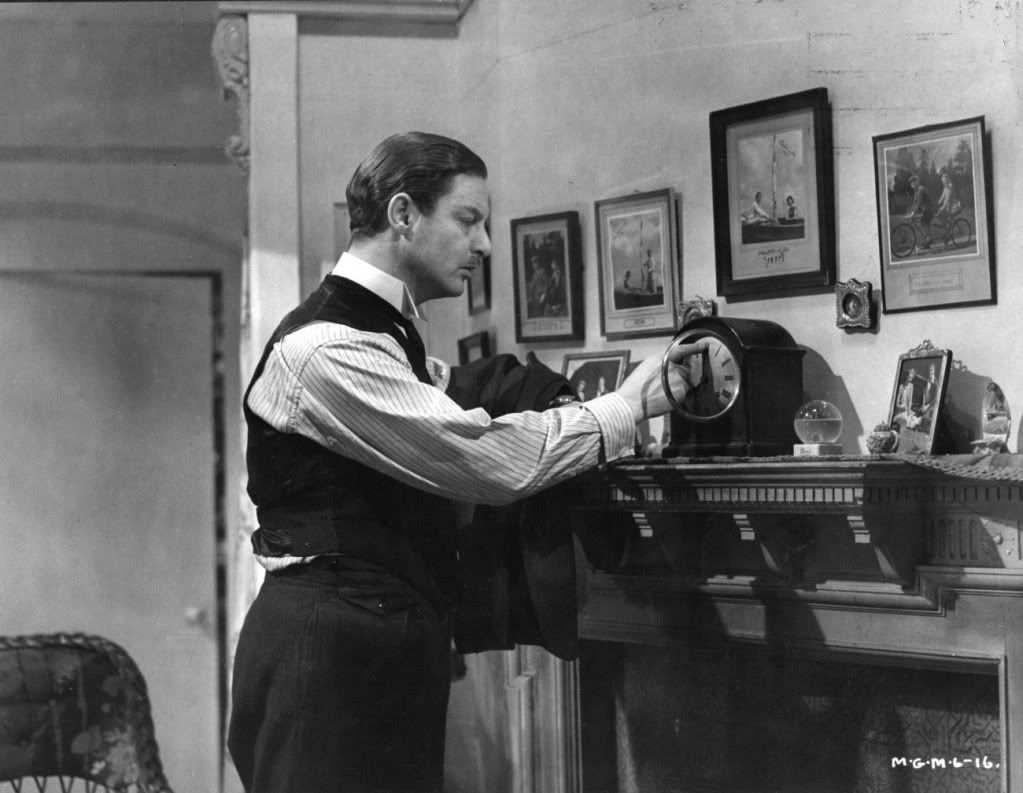
Deborah Kerr and Robert Donat look amazing in their naval uniforms.

One thing you can say about the second world war, it really did wonders for the sex lives of the English. For some reason the line from Hope and Glory, comes to mind, "Thank you, Adolf."

In Vacation from Marriage (or Perfect Strangers as it was billed in England) the Wilsons are a nice quiet couple who are feeling middle age closing in fast while they are stuck in a cramped flat with no view and the prospect of another day of uninspiring work ahead of them. Kathy Wilson (Deborah Kerr) has a perpetual head cold and an even more perpetual look of glazed dispair. She eschews dancing and makeup to humor her stuffy, mustachioed husband (Robert Donat) who is a clerk in some sort of soul-crushing British business enterprise. Even their vacations at the requisite Clacton-on-sea have grown stale. You could set a watch by their movements until Mr. Wilson is sent off to the war in the service of the Navy. His wife, bored keeping up with her taxing nose-blowing and clock winding duties joins the The Wrens, a female service corps of the Navy. Their physical health improves with regular exercise and their personalities are spruced up a bit with danger, independence and a change of scene. Kerr especially blossoms before the camera, moving from an almost flat blank face to the pin up girl with a brain we see her as at the end of the film. She pilots a boat up the Themes in an air raid, and I would say it worth the danger for the effect that it has on her hairdo and the amazingly cute sailor's uniform she gets to wear. I would have joined the Wrens just for the duds!

Both of the Wilsons have wartime romances with partners far more dashing than the spouses they left behind, meanwhile they describe the other to their friends in a mixture of affection and loathing that is really unique to the film. The war scenes are short, but well-filmed and effective. There is a feeling of genuine danger, perhaps owing to the fact that they were filmed in authentically blitzkreiged London. After three years apart, the couple are reunited on a ten day leave. Each plans to ask the other for a divorce. What I expected was a quick denoument, the equivalent of the Pina Colada Song with air raid helmets, but the actual ending was more fulfilling than that. After fighting all night long, the couple who never had so much as a harsh word before the war, are reunited as the sun comes up and it is suddenly clear that German bombs have taken out the high wall that encloses their suburban neighborhood from a spectacular view of the city below.

Though the film is billed as a comedy it is pretty short on laughs. Vacation from Marriage is still an absorbing romance with excellent acting and production values. Director Alexander Korda makes war-torn London seem beautiful and exotic.

Monday, February 23, 2009

Eye Candy of the Day: The Curious Case of Mr. Chips

With the Curious Case of Benjamin Button walking away with the Best Special Effects Oscar last night, I thought it was time to dig out Goodbye Mr. Chips (1939) as another example of a movie where a man goes from old to young and then slowly back to very old in the space of two hours. The make-up in this movie was excellent. It wasn't until a half an hour in that I realized the actor playing Chips was the very dashing Robert Donat (The Thirty-nine Steps). He appears briefly as a young man, clean shaven, much as you see him above. Though by the time he catches up with Greer Garson, he is middle aged and wearing a shaggy unkempt mustache and some fairly convincing lines around his eyes. He spends about 75% of the movie as an old man and Donat's characterization of the spry, springy Chips is really convincing. Donat deservedly won the best actor award for his emotional transformation from a shy, tired man, always on the edge of the action to an energetic force for good. Chips' revolution is one of tea and cake and good humor, but those things were sorely lacking in his environment and they make a difference.

I have avoided this movie because it is spectacularly maudlin but I tend to forget that at its heart beats a really sweet love story. Garson and Donat are lovely together. Mr Chips meets his wife while hiking in the mountains in Switzerland. They are trapped together in a fog and the altitude allows the shy, overly-Victorian Chips to actually put the moves on her. Garson's character is very modern, a fact which the movie eases into place by labeling her a revolutionary. One of the truly delightful scenes in the movie has Chips introducing her to his stuffy colleagues at Brookfield school. Expecting a much older woman, they fall over themselves trying to impress her. It's nice to see poor Chipsy get some respect after always being the good sport in the movie.

It doesn't last long, though and the movie morphs into a wartime tale of an elderly man being useful in a time of crisis. Of course this is to be expected given the year the movie was made, but the film has a very dark take on the theme as boys who are one day in boaters and short pants are the next being referred to in a roll call of WWI dead. I was reminded of my visit to Cary Grant's school in Bristol and how there is plaque there filled with the names of dozens of former students killed in action who were just a few years older than Archie Leach.