Showing posts with label Alfred Hitchcock. Show all posts

Saturday, November 21, 2009

Foreign Correspondent (1940)

The lesser known and loved of the two great films put out by Alfred Hitchcock in 1940 (the other being Rebecca), Foreign Correspondent is sometimes lost in the shuffle of Hitchcock's oeuvre. While I watched this movie in a film class at some point, I mainly remembered the famous umbrella sequence and that some of the plot devices are later rehashed in North by Northwest. Coming back to the movie with my obscure actor love goggles on, I can't believe how jam packed with awesomeness this movie is and I didn't even know it till a week ago.

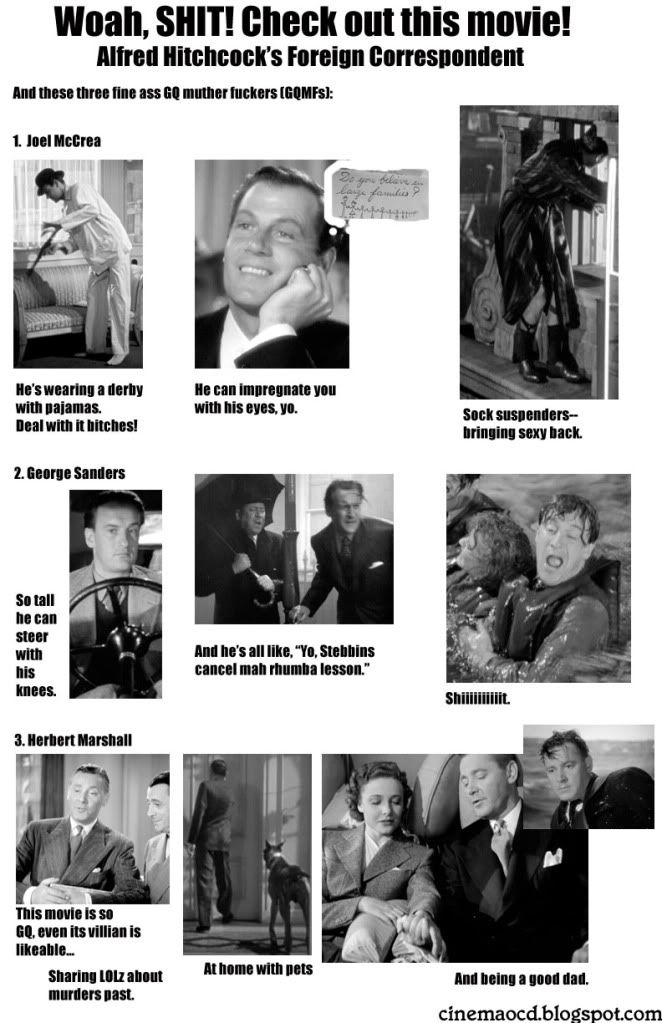
I always feel that while commenting on Hitchcock movies that I have to really struggle to say something new. I tried doing a picspam commentary on Murder! which, based on the number of comments I received, was met with crickets chirping. This time I'm really going to shake things up with a macro using a fairly popular internet meme created by the ONTD livejournal communities.

So here goes, the first ever OCD Macro, printable at the 11x17 tabloid size, if you REALLY wanna show your love for Cinema OCD.

And while we are showing mad love for George Sanders, please enjoy this lovely, in-depth article about him. Watch him in one of best be-monicled scenes here.

Thursday, September 3, 2009

Eye Candy of the Day: The 39 Steps

Robert Donat and Madeleine Carrol are literally shackled together and shacking up in Alfred Hitchcock's adventure thriller the 39 Steps (1935). Richard Hannay (Donat) steps into a music hall to divert himself and before long finds himself hip deep in a spy ring, beautiful women, racy sleeping arrangements, and murder. The action begins with a pick-up: a mysterious woman in a veiled hat invites herself up to Hannay's apartment and winds up dead a few hours later. Hannay borrows her ploy of using sex to get what he wants and finds women mostly willing to go out of their way to help him. Hitchcock exposes a society ready always to believe the lascivious and vicious before the innocent truth. Of the three women Hannay ends up spending the night with he falls for the one he fights with (Madelaine Carrol) which is true to the spirit of the screwball comedies that were bubbling up in America.

There's an interesting and poignant interlude on the Scottish moors with a woman who is completely swept off her feet by the dashing mysterious stranger who has stumbled briefly into the miserable cottage she shares with an even more miserable husband. The film leaves her behind, but not before she gets the memorable chance to make a noble sacrifice for him and get a kiss from our hero. She's like the fleshed out version of the woman into whose hospital room Cary Grant passes through in North by Northwest. Speaking of which, The 39 Steps is remarkably similar to that later more famous Hitchcock film. Both movies use a man on the run from the police as an excuse for a cross country chase and a series of entertaining adventures as he dodges the law, deadly thugs and prevents a master spy from stealing important military secrets. The focus of North By Northwest is a sweeping, technicolor travelogue while The 39 Steps has a more intimate agenda. Unlike the larger than life characters that inhabit North By Northwest, the supporting cast in 39 Steps insinuate themselves quickly into the memory and seem like real people glimpsed in the midst of their daily lives. That moment in North by Northwest when Cary Grant is treated like the movie star he is by the woman in the hospital room, is funny because the audience is in on the joke of the whole stylized, over-refined universe. And a similar moment in The 39 Steps is completely uncynical and poignant because Hannay begins his flirtation with crofter's wife as part of a role he's playing and ends with his genuine concern for her welfare. His good-bye kiss is what is required of the part but you can see him conflicted about the game he's played.

In both movies, Hitchcock seems to enjoy torturing his heroes, putting them not only in constant peril, but continually uncomfortable, awkward and embarassing situations. They get hungry, tired and dirty along the way (though not quite as much as mortal men would) but they never seem to get lonely! If there's one thing you should learn from these movies its this: chicks dig fugitives.

Thursday, August 13, 2009

Murder! (1930) Picspam

There is an awesome website called "1000 frames of Hitchcock" that is part of the extensive Hitchcock Wiki. The site does just what it sounds like it does: they post 1000 frames from every Hitchcock film. The people who are doing this must really love Hitch. Doing a picspam of 60 frames is a huge amount of work, let alone 1000. It was worth the effort though, as the result reveals Hitchcock's greatness in a unique and powerful way. You can select just about any frame at random and find an artfully composed, striking image. He really was an artist hiding out in the world of popular entertainment.

I've gone through "1000 Frames" and selected my favorites from the 1930 film Murder! which I recently watched for the first time. I put my comments on the film as captions to the pictures. Rather than make my blog impossibly hard to load, I've put this in my live journal. You can see the whole thing here.

A note on other picspams: I still have not finished the Big Chill Picspam. All the captures are done and processed, but I haven't had a chance to put it together. I have yet another picspam of the Bull Murray film Razor's Edge, which I'm also going to try to post soon as well.

Thursday, April 30, 2009

Caryvention IX

Cary Grant tickles Genevieve Tobin in Kiss and Make Up (1934).

I'm back too soon from my seventh Caryvention, CVIX, in Chicago. It's always tough to say good-bye at Caryvention, and this year was no exception. I miss everyone already. Our hosts, Lynnette and Kim really outdid themselves. What a rush it was to pick up the program for the Music Box theater and see "Caryvention presents." I don't know how you guys swung it, but hats off too ya! As always all the warbrides went mental with the gifts. One dedicated warbride wrote to Eva Marie Saint and got her to send us an autographed statement about how much she loved working with Cary. My goody bag is truly awesome. Thanks everyone!

The Warbrides celebrated the fiftieth anniversary of North by Northwest in style at the Ambassador East Hotel in Chicago. It was such a trip to walk up and down the staircase into the hotel every day that Cary uses in the movie. I'm such a dork, I had to walk the path that Cary walks toward the hotel in the exterior shot.

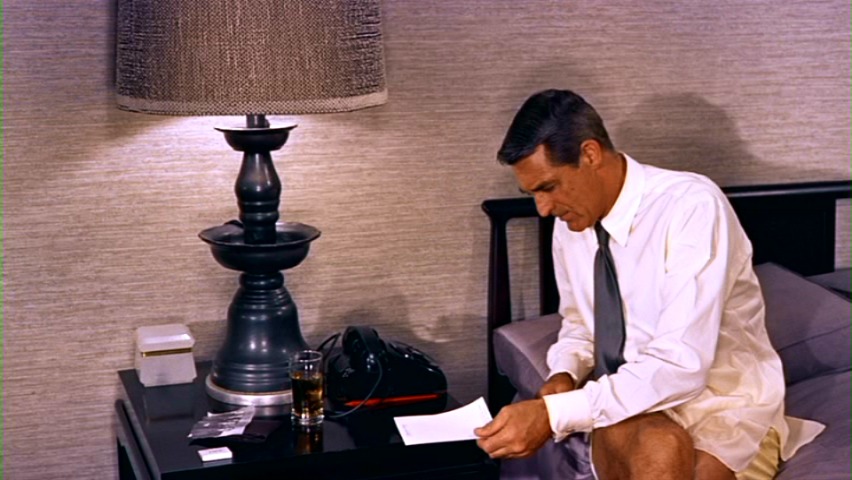
The highlight of the week-end for me was watching North by Northwest on the big screen of the Music Box Theater with the other warbrides. I have seen the movie twice before in a proper theater, but this time was definitely the best. The only thing better than watching Cary on the big screen is watching him on the big screen with a room full of fanatical fans. There were three warbrides who came from far corners of the earth who had never had the opportunity to see him on the big screen before. Janine, Natalie and Irena, I hope it was worth the trip! If only to see the yellow boxer shorts in larger than life format.

We also watched Kiss and Make-up, one of my favorite Cary pre-code films. I first watched this film on the big screen with the Warbrides at the DC Caryvention and it's always held a special place in my heart because of that. While this isn't a great movie by any stretch of rational measure, it is completely and utterly fun to watch in room full of semi-reverent warbrides. It's a high-energy comedy about a man who runs a beauty spa and the women in his life. It also has a love song to corned beef and cabbage. As the projectionist at the teater in DC said after screening it for the first time "Where has this movie been all my life?" I'd like to see watching this movie become a Caryvention tradition where we could give it the "Rocky Horror" treatment.

After the movie screenings, my favorite part of Caryvention is the random Cary Grant or other film conversations I have with other Warbrides. Turns out there's a big Jane Austen/Cary Grant cross over that I haven't had a chance to quite process yet, other than to think about finding a way to put my awesome Jane Austen "boots and shirtsleeves" screensaver on line for you.

I have a ton of other movies to blog after my two week break, so I'm gonna wrap this up by saying, "Happy Thoughts!"

Friday, December 5, 2008

Jamaica Inn

Charles Laughton and 19-year-old Maureen O'Hara in Jamaica Inn (1939). The pair had kind of a creepy chemistry which worked to the advantage of this picture as well as The Hunchback of Notre Dame later that year.

Jamaica Inn feels almost as much like a Tod Browning movie as it does an Alfred Hitchcock film. It creates a dark mood, full of grotesque characters and swirling seas. To me the words "Jamaica Inn" conjure up a caribbean resort or perhaps a lair for pirates. The latter is close to truth, as the Inn is a dilapidated hotel on the stormy Cornish coast that is home to a band of ship wreckers-- cutthroats so nasty, each one is more bizarre and devilish than the last. In one scene a man is hung and two of the wreckers fight over the buckles on his shoes before he's even dead. Further adding to the piratical air of the film, is hero Jem Trehorne, portrayed by Robert Newton the patron saint of "Talk Like a Pirate Day" who is best remembered for his portrayal of Long John Silver in Disney's Treasure Island.

When young Mary Yellen (O'Hara) goes to visit her aunt on the storm-torn coast of Cornwall, the stage drivers refuse to stop at the desolate Inn. She is dropped off instead at the estate of Sir Humphrey (Laughton) a lecherous old aristocrat who lives for lavish dinners and the occasional pretty face. We learn that Humprey's ancestors have all gone mad and Laughton gives us every indication that he's got his ticket to Happydale all but punched and ready to go.

The movie devolves into an extended chase when Mary rescues Newton's character, the 19th century equivalent of an undercover cop, from the wreckers. In one sequence the pair wind up stranded in a cave that gets cut off from the mainland by high tide. The romantic setting is reminiscent of Hitchcock's later travelogue films that made great use of location. Jamaica Inn isn't a great Hitchock film but it's quite a bit of fun and Laughton is always worth watching.

Thursday, November 13, 2008

Eye Candy of the Day: Strangers on a Train

Farley Granger and Kasey Rogers in Strangers on a Train (1951).

I didn't appreciate until yesterday, just how visually arresting this Hitchcock film is. From the murder reflected in the victim's pair broken glasses to the noirish gleam given to our nation's capitol, this is one Hitchock's most beautifully made movies. The story of an ambitious young man with political aspirations and dreams of the golden girl who is inconveniently tied to a woman he wants to be rid of, is reminiscent of A Place in the Sun which came out the same year. Ruth Roman who plays Granger's love interest even reminds me a bit of Elizabeth Taylor. While A Place in the Sun has all around superior performances from the actors, and probably a better script, Strangers on a Train is one of Hitchock's most concentrated and successful efforts at building an atmosphere of suspense. In one scene a lone figure standing on the steps of the Lincoln memorial in stark broad daylight is reminiscent of the dreamscapes from Spellbound. We see the figure from Granger's perspective, never knowing whether or not the figure is psychopath Bruno Anthony (Robert Walker).

Walker's performance is chilling in its intensity. The young actor was briefly hospitalized for a nervous breakdown before making the movie and committed suicide shortly after production finished while working on the feircly paranoid anti-communist polemic, My Son John (1952). The context of the Red Scare is part of the tense feelings in Strangers as well. Though it is a-political, the movie is set in Washington and the protagonist is a young man working in the office of a prominent Senator. The fear of scandal hangs over most of his decisions and prolong his troubles. In another scene he sits in a dark suit in a crowd full of tennis fans clad in white. As we watch their heads moving mechanically left to right with the match, Walker looks straight into the camera which moves quickly in on his face. It's one of those terrifying forward camera moves that Hitchcock would use most famously in Psycho (1960) and Vertigo (1958), but perfected in Strangers on a Train.

Monday, July 28, 2008

The Women of Rear Window

I've been wondering what I could possibly have to add to the mountains of analysis that have been written about Hitchcock's Rear Window. Critics tend to focus on the theme of voyeurism which is a recurrent one in his work. But Rear Window deals heavily with another of Hitch's recurring themes: the plight of the unmarried woman. He comes back to this theme over and over and yet, it is almost always seen as part of the romance, which is not always taken seriously by film critics. Now that I've sufficiently beaten up on film critics in general, I'll name some names. Roger Ebert in his excellent essay on Rear Window sees the romance part of the film merely as a way to expose Jeffries' psychological problems, his assumed impotence and obsession with voyeurism. This is pretty typical and I think what Ebert does best is distill that mountain down to a concise readable version of what has come before. Seeing the romance as the "b-storyline" in Hitchcock is completely wrong-headed. Not only is the romance element enjoyable in and of itself, it is almost always the heart of the theme, driving the action forward.

Rear Window is the story of a photographer, L. B. "Jeff" Jeffries, (Jimmy Stewart) who is injured on the job and spends his time convalescing in a hot Greenwich Village apartment, watching his neighbors out his window. After the initial set-up of the apartment complex, and its cast of characters, Jeffries' nurse Stella (Thelma Ritter) arrives and gives him some rather plain spoken advice about his weird hobby. She keeps this in a light teasing tone, and Jeffries' response is that of an errant child who is so cute he can continue to get away with his misbehavior. Stella moves on to the topic of Lisa Fremont (Grace Kelly), Jeffries' girlfriend. Having established this maternal role, she goes on to give him much unsolicited advice about his love life. Stella thinks he is an idiot for not marrying Lisa Fremont who is beautiful, talented and in love with him. He accuses her of being on Lisa's payroll. This is a joke, of course, but it spells out his attitude toward women.

Where women are concerned Jeffries is always distanced an cynical. Marriage is a trap laid out for all single men. This is first illustrated by Mrs. Thorwald, who will eventually be the victim of a murder, but before that, she is a nagging, unhappy invalid who requires constant care by her husband. We also witness the start of a marriage as a pair of newly weds move and their exploits are dramatized through a drawn shade and the comical attempts of the young husband to gain a reprieve from his amorous wife. These are familiar tropes, but the effect of placing them here, with Jeff's fear of marriage clearly spelled out is to show, supposedly why, he dislikes the institution so much. Jeffries is most comfortable with Stella perhaps, because she is happily married. When she cooks him a nice meal, he says that he knows why her husband still loves her. Stella, though down to earth and practical reveals herself as a romantic. She says that people should come together like two taxis on Broadway.

Two more characters in the apartment complex have important things to say about marriage and they are Miss Lonelyhearts and Miss Torso. Miss Lonelyhearts is a woman in her early forties who dresses up and has pretend dates with imaginary gentlemen. Jeffries laughs at her at first and then feels sorry for her as she ends her evenings alone, crying and drinking. Miss Torso is appropriately named for she represents a big part of voyeurism and male view of women. She is merely a torso, a piece of a whole person, the most interesting part for a man watching across a courtyard, to be sure, but Hitchcock, before the end of the movie will show us more than just her torso.

Lisa is introduced with one of those showy Hitchcock camera moves. She is in extreme close-up and looms over Jeffries in a way that makes the audience uncomfortable as we've grown comfortable along with him watching people at a distance. As Lisa moves about Jeff's apartment preparing dinner, Jeff watches Miss Lonelyhearts making dinner for her imaginary date. Lisa comes in at the end of her preparations as she's crying. Jeffries tries to cheer Lisa by saying that she'll never be like Miss Lonelyhearts. Lisa replies "oh, you can see my apartement from here, too?" Perhaps it is impossible to imagine her in the same desperate corner, but it's pretty clear that Lisa feels a real connection with Miss Lonelyhearts, er, loneliness. Next they turn their attention to Miss Torso's apartment where the "bikini bombshell" is entertaining three men with cocktails and flirtation. Jeffries says that this is much closer to Lisa's apartment. Lisa comments that Miss Torso is doing woman's most difficult job: juggling wolves. Jeff adds cynically that she's picked the most prosperous looking wolf, but Lisa argues that she doesn't love any of them and hints that she knows about this from experience.

Lisa is charming and sympathetic and lovely. She's everything that Stella said and more. She's also a walking wound of insecurity. She reads disinterest, distance and dislike in almost everything she does that night and she's not far off. What follows is a fairly civilized break-up which ends with Lisa flopped casually in the seat opposite Jeffries' wheelchair. They argue, they go round and round the same topics: he's an adventurous photographer who spends most of his time abroad and she's a fashion model who lives in the world of lunches at 21. This is a familiar scene for anyone whose spent anytime in the dating world. Perhaps the details are more glamourous, but the net result is the same. Two people love one another, but not quite enough to change their lives. It's painful to watch someone go through it and yet, it's kind of comforting to see "perfect" Lisa have to live through it too. After a long tedious discussion that finally comes to the conclusion that the worlds in which Lisa and Jeff live can never be brought together, he maddeningly asks when he will see her again! His implication is that though there is no future for them together he wants to continue to have her company as long as he's in his cast. Am I the only woman watching this who wants to pull a Raymond Burr and throw him out the window an hour early?!

After Lisa leaves, the murder is committed which takes Jeffries hobby into a deep obsession. He spends the rest of the movie trying to prove what he saw and eventually Stella and Lisa join him in the belief that Thorwald has murdered his wife. When Lisa begins to watch alongside Jeff, there is a change of sympathy toward women. Watching Miss Lonelyhearts' first date with an actual man, Jeffries comment is "he looks a little young for her." (Ironically Stewart was five years older than Judith Evleyn, the actress who played Miss Lonleyhearts). Lisa says nothing but reacts in horror when the man attacks Miss Lonelyhearts who throws him out of her apartment. Lisa rings down the blinds on their voyeuristic activities for the night.

As the movie goes on, Lisa's pluck and resourcefulness in smoking out Thorwald prove her mettle to Jeffries. In one critical scene she enters Thorwald's apartment to search for evidence. Thorwald returns and Jeff and Stella are supposed to phone the apartment to warn her to get out. They are distracted by Miss Lonelyhearts who is about to commit suicide by taking too many sleeping pills. It would seem that Hitchcock is trying to show us that in her way, Lisa is as fragile and vulnerable as the pathetic Miss Lonelyhearts.

Ultimately Lisa prevails. She gets her man. She has to risk getting her neck wrung by a murderer but that would seem a small price to pay to win the heart of the man she loves. The whole action of the second half of the fillm serve as an audition in which she proves that she's adventurous enough to be his mate. It is not till Jeffries views her at a distance in Thorwald's apartment, when she becomes part of his voyeuristic fantasy life, that he falls for her. Strangely enough, this doesn't seem to be a problem for her. Though Stewart is the hero of the film, he is trumped by the heroine who sits in control at the end (literally wearing the pants) happily reading a fashion magazine while he doses in his now double cast. Miss Lonelyhearts too triumphs in the end. She hooks up with the composer whose music distracted her and prevented her from killing herself. They seem to be soul mates as his romantic theme wafts down from his studio to Jeff and Lisa together. Hitchcock throws out a final bit of comic irony when Miss Torso's boyfriend returns home from the army. He is a good head shorter than she is and certainly isn't the most prosperous looking wolf. And yet she adores him.

Sunday, July 13, 2008

The Trouble with the Trouble with Harry

The Trouble with Harry is great fun. Though I've known the basic plot outline for years, in its incarnation as one of the best episodes of my favorite show, Remington Steele, I only took the trouble to watch the Trouble with Harry today. (And if you think that's the last time I'm going to use that overburdened sentence construction, honey, you just don't know me!)

It fits in perfectly with the other two Hitchcock films I've been talking about this week, Notorious and The Lady Vanishes. Those two movies balance comedy, romance and thrills with Notorious being heavier on the romance and thrills and The Lady Vanishes being more about the funny. The trouble with Harry upends the balance much more toward comed. There is very little suspense, no horror and nary a thrill in sight. Audiences responded by staying home in droves and Hitchock, I guess felt he'd learned his lesson and returned to more conventionally Hitchcockian plots. Only Mr and Mrs. Smith, is further from feeling like a Hitchcock picture.

The story follows a long day in the life of a sleepy New England town after a body is discovered in the woods. The main joke of the film, which gets told in the first five minutes and then is simply repeated in variation throughout, is that no one gets too bent out of shape about the body. The victim's wife, played by Shirley MacLaine, seems overjoyed, but not in a ghoulish, murderous way. The man who discovered the body, Captain Wiles, (Edmund Gwen, whom I know best from his role as Mr. Bennet in the 1940 version of Pride and Prejudice) assumes that he accidentally shot the man, and seems only bothered that he might get mixed up in a police inquiry. Sam Marlowe, the local extroverted bohemiam painter played by John Forsyth, decides to help hide the body out a growing romantic interest in the widow. A local spinster, Miss Gravely, played by Midred Natwick (Widow Trillane from The Quiet Man) also finds romance by being bound up in the conspiracy.

Hitchcock is always sympathetic to the plight of single women. It's one of the reasons I've continued to love him over the years. I've always wondered if that was the influence of his wife and writing partner, Alma Reville. At any rate, Shirley MacLaine plays a single mother with a complicated back story that just skirts the edge of Fifties family content and her son, played by none other than Jerry Mathers, "the Beaver," is the product of her brief first marriage that inexplicably also ended in death. Maclaine in her debut film role plays Jennifer Rogers as breezy and nonchalant despite her bad luck with husbands. Her answer to every crisis is to make lemonade. As a parent, I can appreciate this. There's almost nothing that a nice glass of lemonade can't fix. Hitchcock doesn't push Ms. Roger's sexuality. There are few close-ups, Edith Head's costumes are uncharacteristically restrained and the kisses are all well-chaperoned. In short, he does everything he can to keep her from becoming a stereotypical Black Widow.

Miss Gravely is my favorite character in the film. Seen by the town as an uptight spinster, Sam Marlowe gets his kicks by giving her a make-over in the general store after humiliating her by guessing her age as 50. She tells him, clearly stung, that she is 42, and perhaps out of guilt, he proceeds to arrange a haircut and make-up for her to "take ten years off her birth certificate." Ironically, Natwick was 50 when she played the role and her character has already done the job of attracting Capt. Wiles long before her make-over. Gravely maintains her dignity throughout and Hitchcock never turns the romance of the older couple into a cheap joke. Consequently they are simply a less glamorous counterpoint to the more worldly youngsters who frequently make-out in their presence.

The dilemma about what to do with the body is the Macguffin which drives forward most of the plot. It's hardly the uranium ore of Notorious and even the town cop is more concerned about maintaining his old jalopy than proving foul play. This lack of urgency is what gives the movie such a pleasant, leisurely pace. One has plenty of time to enjoy the technicolor autumn in New England as the conspirators mosey up and down the picturesque lanes burying and exhuming the titular character. The comedy is loose and laid back, too. There are no Week-end at Bernie's antics and the corpse is allowed to maintain his dignity mostly by being seen only in wide-shots that don't ever dwell on his face. I suppose, that audiences found with the Trouble with Harry to be too out of character and too light-hearted. The trouble with the Trouble with Harry is that there's really no trouble at all.

Wednesday, July 9, 2008

Notorious: by the ticking of the champagne clock


I first glimpsed Alfred Hitchcock's masterpiece, Notorious in college. A journalism professor showed us the scene at the party with the key and the device I've come to call the "champagne clock." I don't remember what the teacher's point was, I just remembered the bliss of seeing my beautiful Cary on the big screen in class. After that, I sought out the movie in the library, marveling at the obsessive craftsmanship of the director in balancing the tension of scenes like the champagne clock with the moments of humor and the swooning romance.

Notorious is a sophisticated movie. It acknowledges that there is such a thing as sex and that it doesn't always happen in marriage. The title at first seems to refer to Ingrid Bergman's character Alicia and her bad reputation, but as the film goes on it becomes increasingly ironic. Alicia grows ever more vulnerable and desperate, and is the victim surrounded by playboy spies, murderers and mother-in-laws. Even the supposed bad guy, Alex Sebastian, played by Claude Raines is to be admired for his good taste in women and pitied for his over-bearing mother, who is the real villain of the piece.

Bergman's performance is wonderful. She is achingly insecure one minute and quite funny in the next. My favorite scene is the one in which Cary Grant's Devlin returns from the meeting where he's gotten the assignment to have Alicia seduce the evil Nazi played by Claude Raines. He is suddenly cold toward her, but she doesn't realize right away and chatters on happily about how her chicken caught fire once while it was cooking. How could any man resist her sweetly amusing Swedish sing-song love patter? How come Devlin doesn't just drop to his knees, declare his love and tell his bosses to go drink some of Mrs. Sebastian's delicious coffee? I guess there wouldn't be a movie if he weren't such a fat-headed guy full of pain.

Cary Grant also gives a layered performance. He is tough, and glib in all his interactions with Alicia, but there is just a glint of sentimentality in him that comes gushing out in genuine sentiment in the final love scene with Alicia. The famously long embrace looks so passionate in stills, but is quite gentle and sweet in the context of the film. Cary's voice is hushed, his dialog almost rushed as he must quickly declare his love, keep Alicia alive and moving out the door, all the while planning an exit strategy for his rescue. When Claude Raines appears he turns back into the Iceman, giving him that same hard side that he always showed Alicia, all the while continuing to whisper encouragements in her ear. When he guides her slowly down the stairs he looks as if he were balancing on a tightrope (or on the roof of a French Chalet, perhaps?) . Cary Grant got his start in show business as an acrobat and once you know that fact it's difficult not to see him as a stilt walker pulling off the illusion of ease in an uncomfortable situation.

Hitchcock indulges in plenty of camera "gimmicks" showing Devlin only from the rear in the first scene, turning his image upside down when Alicia has a hangover and using strange lighting and focus effects to dramatize Alicia's illness. Some of these experiments work (the upside down Devlin) and some fail and become distracting (filming Devlin from behind.) I don't think Hitchcock's importance as a director lies necessarily in those innovations of his. I think it has to do with the overall incorporations of his obsessions (and I know a thing or two about those!) into his art. The mother-in-law is a variation on Mrs. Danver's from Rebecca and like Danver's, Hitchock hints that she has some kind of unhealthy sexual obsession, in this case with her son. In Bergman, Hitchcock found the first of his cool, but passionate blondes. When Bergman left Hollywood she was replaced first with Grace Kelly and then with Eva marie Saint and Kim Novak. Yes, Notorious is definitely a good place to start for a blog that is about Cinema obsessions.